Deliveries at KNH Remained Steady During County Strikes. Experts Say This Is A Red Flag.
As county health workers engaged in a recent industrial action, and maternity wards shut across Kenya, one hospital was expected to feel the strain—Kenyatta National Hospital. But national data shows something unexpected: deliveries at the nation’s largest referral hospital barely changed for three months. To experts, that stability signals danger, not resilience.


When more than 10,000 experts gathered in Cape Town in September for the International Federation of Gynecology and Obstetrics (FIGO)—the world’s largest maternal health conference—an urgent message came from Nairobi. At Kenyatta National Hospital (KNH), the country’s biggest referral centre, maternity wards were overflowing.
“My maternity unit is overwhelmed—overcrowded with women in labour, some of them critically ill, with nowhere else to go,” wrote Dr Philomena Owende, Head of Obstetrics and Gynaecology at KNH.
“Some are coming in a moribund state. The situation has become dire. Kenyatta National Hospital cannot accommodate the influx, and with (neighbouring) Kiambu and Nairobi counties on strike, the options for these women are rapidly vanishing,” the distressed doctor wrote.
A brief context: Public health workers in counties near Nairobi, the county where KNH is, went on strike last May, paralysing health services across public hospitals in those devolved units. Expectant women with complications were rushed to Kenyatta National Hospital, popularly known as KNH, as it is one of the few facilities that could provide emergency obstetric care.

Within a 40-kilometre radius of Nairobi, only Thika Level 5 and Kenyatta University Teaching and Referral Hospital, both located in Kiambu County, have comparable capacity. Services were unavailable in these two hospitals as well. The strike was called off last week, but the impact lingers.
“Newborns are having serious issues; facilities are not admitting women. All these expectant mothers are coming to Kenyatta,” said Dr Kireki Omanwa, senior obstetrician and president of the Kenya Obstetrical and Gynaecological Society (KOGS).
The Kenya Medical Practitioners and Dentists Union (KMPDU) said over 130 newborns under one month of age died during the strike. Kiambu County health officials disputed the figure, saying it was inflated.
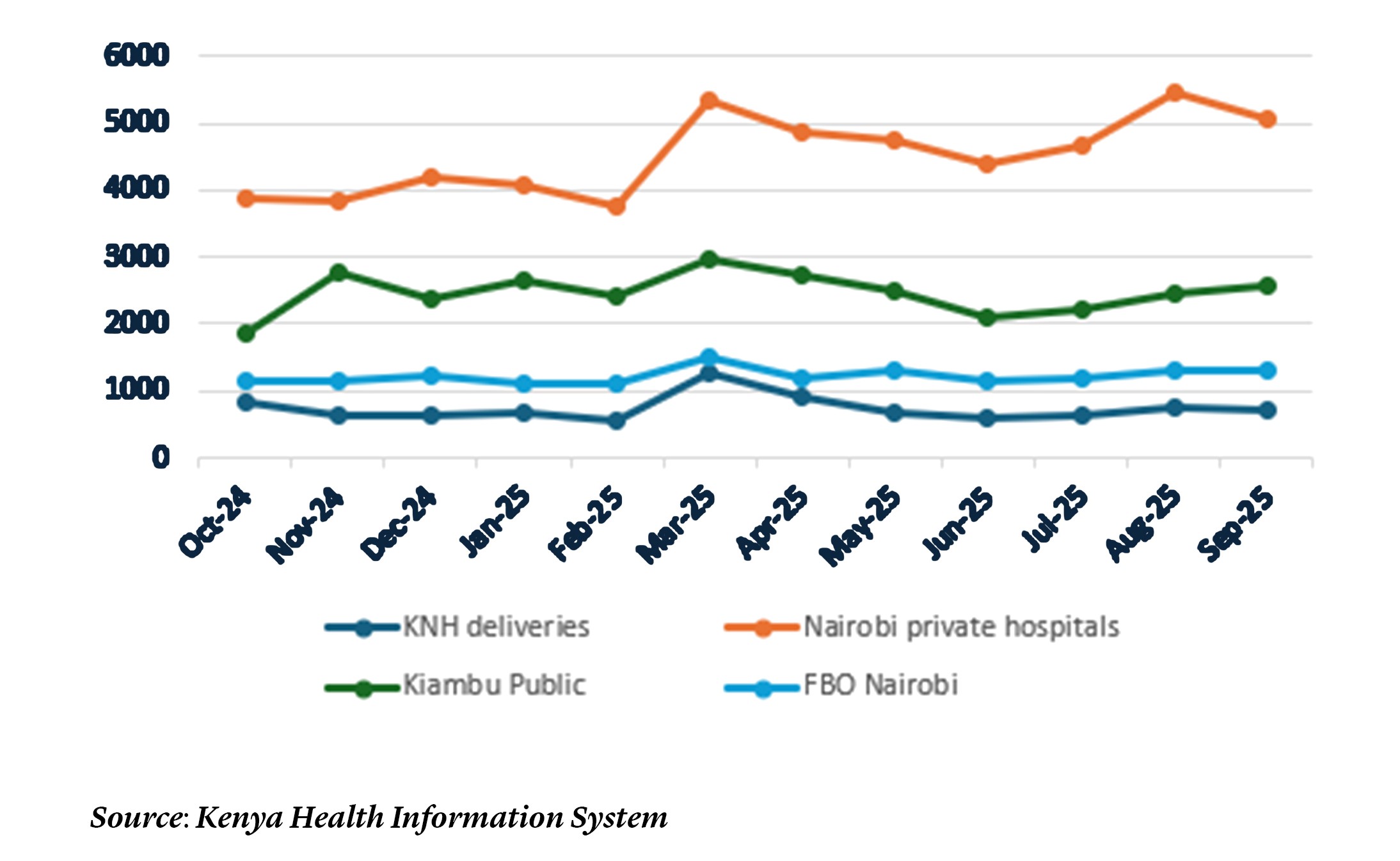
Defrontera reviewed data from the Kenya Health Information System (KHIS)—the national database recording all public-facility services. The data revealed a striking pattern: despite two major referral hospitals being unable to offer emergency obstetric services for more than three months, KNH’s delivery numbers remained largely unchanged.
KNH handles about 780 deliveries a month, mostly referrals. Medics at KNH said that most cases originated from Nairobi, Kiambu, Machakos, and Kajiado. There was no increase in deliveries in neighbouring Machakos or Murang’a either, raising a perplexing question—where did women who rely on public hospitals go for care during the strike?
Hospitals like KNH are central to cutting Kenya’s high maternal mortality rate—around 5,000 women die each year during childbirth. It is one of the only five per cent of facilities that provide maternity services in the country and are fully equipped to offer “comprehensive services,” according to a 2023 Ministry of Health analysis. Comprehensive maternity care includes caesarean sections and blood transfusions. The same report found that only one in five facilities (18 per cent) perform caesarean operations, and just about two in five of those (42 per cent) can provide blood transfusions.
During strikes, when even a few referral hospitals scale down or shut their operations, the loss of these essential services ripples across the entire health system. Dr Owende described what women endure during service disruptions as obstetric violence — a term used in medicine to describe mistreatment, neglect, or abuse during childbirth. A global study estimates that up to 60 per cent of women experience some form of this mistreatment. In Kenya’s overstretched maternity wards, the term now mirrors lived experience: for many mothers, survival depends less on biology than on whether the system around them is functioning.
As to what transpired during that critical three-month window that the strike lasted, the consistent number of infant mortalities provokes a reassessment of KHN’s capabilities as the nation’s premier public healthcare provider and where the mothers sought service.
Share this feature


