Is this the friendliest village for babies in Kenya?
A village elder, a nutritionist, a public health officer, a nurse and a community health volunteer in a small village in an arid area to ensure babies reach age five healthy.


Peter Kimoi is at the local dispensary at Kasei Location In West Pokot County, but neither he nor his family is sick. He's the assistant chief of Kasei and is eagerly awaiting the outcome of a woman in labour in the health facility and attending a community meeting to discuss making Kasei the friendliest place for babies.
Peter is the chair of Kasei's committee on the Baby Friendly Community Initiative (BFCI) committee. The chief and the committee members aim to give women, families, and communities a support system to improve maternal, infant and child nutrition during the first 1,000 days of life.
80% of a child's brain develops between conception and their second birthday, requiring nutrients. Unfortunately, even with adequate nutrition after that, there is little evidence of brain repair. He and the committee make it easier for women to seek medical care when pregnant. He had visited the woman in labour in her home when she was expectant to ensure she ate adequately and visited the health centre for the four recommended antenatal checkups.
"She joked that they would name the child after me, so I am here waiting to welcome another Peter Kimoi to the world," he said, bursting into thunderous laughter.
He is in one of the nine BFCI committees in West Pokot County. Community members participate in several activities to ensure that a child's life is on the right path from conception to birth and during the first five years of their lives. For example, the Kasei committee has a representative from the youth, a public health officer, a nurse, a community health volunteer, a local administrator such as Peter Kimoi and a representative from the mothers.
Lifesaving information
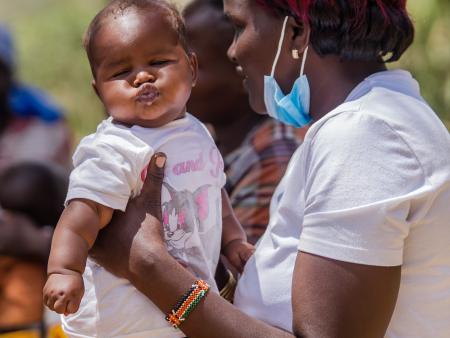
Kasei's BFCI committee also works with mother-to-mother support groups, which are regular gatherings during which women share their experiences of motherhood and family. Jane Limang'ura, the head nutritionist in West Pokot County, said the county's health department formed the mother-to-mother support groups with support from the non-profit Action Against Hunger. Whenever the mother-to-mother support groups meet, public health officers and nutritionists join them to share lifesaving information, such as the need to visit the hospitals and danger signs to watch out for when pregnant. They also learn how to breastfeed and introduce complimentary meals to the babies.
Naomi is a member of the Kituti Mother-to-Mother Support Group in Kasei. Like many mothers in West Pokot, she relies on the knowledge from the older women on raising her children. While well-meaning, some of those lessons may have set the children and the mothers on an unhealthy path. For example, Naomi confesses that she introduced foods to her infants as early as three months instead of exclusively breastfeeding the baby for the first six months.
"I gave my first child things like gripe water and food whenever the baby cried because I was taught that means the baby is hungry and that breast milk will never be enough," Naomi said.
Exclusive breastfeeding
The World Health Organisation champions exclusive breastfeeding, which means the mother gives the infant only breast milk. The child should not take any other liquids – not even water – or solids, except oral rehydration solution or drops/syrups of vitamins, minerals, or medicines prescribed by a health practitioner.
The WHO states breast milk contains all the nutrients an infant needs in the first six months of life and protects the baby against diarrhoea and common childhood illnesses such as pneumonia. In addition, breastfeeding "may also have longer-term health benefits for the mother and child, such as reducing the risk of overweight and obesity in childhood and adolescence", the WHO stresses.
Naomi was keen to follow the recommendations from Yvonne Chemutai, the nutritionist in Kasei who would visit Kituti's Mother-to-Mother Support Group. Naomi followed the counsel right from when she was expectant all through the first months of her child's life.
"I learnt that I needed three main meals, two snacks and an extra meal when I was pregnant, and I even delivered in the hospital," Naomi said.
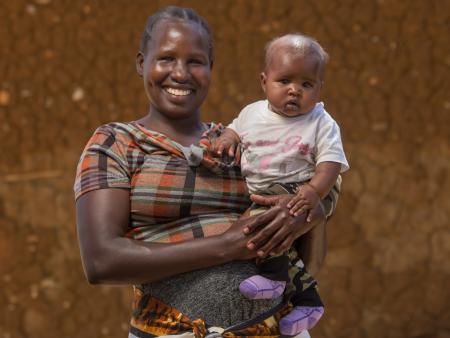
"I have been breastfeeding my child, and you can see how healthy she looks at three months," Naomi said.
At a gathering in Naomi's home, the Kituti Mother-to-Mother support group members hang on to the words of the nutritionist Yvonne. They trust her and the information that she is giving them. The mother of three says that she was not particularly keen to deliver in a health facility. The 2014 Kenya Demographic Health Survey reported that while more than 80 per cent of women in West Pokot got antenatal care with a skilled provider, only 27 per cent of them delivered at the hospital with a skilled provider. Due to ignorance, access and lack of support, women chose to have their babies at home with traditional birth attendants. Most of the deliveries are successful, but sometimes there are life-threatening and often fatal consequences that the traditional birth attendants, without any medical knowledge, are ill-equipped to handle.
Food diversification
Assistant Chief Peter said that a lack of support at home and the fixation on culture hinder women from regularly seeking medical care and eating nutritious meals for a healthy pregnancy. A man respected in his village, he uses his social capital to talk to fellow men in the households he visits to escort their wives to the hospital. He also encourages them to provide a means of transport if the facility is at a distance. In these conversations with men, Peter stresses the need for the men to support food diversification in the house.
Peter narrated: "I only learnt from these meetings with Action Against Hunger that vegetables, which is not something we, the Pokot, grow and like feeding on, is important for our immunity, and so I remind the men to take advantage of the river near us to grow the vegetables."
These efforts — the community health volunteers' home visits, the mother-to-mother support groups, and Chief Peter using his social capital — have borne results. William Merisia, the county's public health officer based in Kasei, said: "I cannot say by what percentage the decline is, but the number of typhoid and other water-borne diseases has reduced."
Mr Merisia added that the number of women coming to the health facility for their checkups and deliveries has also increased.
Share this feature