Inside Kenya’s strategy to fill the KES 28B annual funding gap in HIV care left by USAID
Following the immediate halt of USAID programs, Kenya is set to lose another KES 11 billion in other investments that the United States Government set aside for social services for those living with HIV.


At the beginning of the year, Kenya — a country with a national HIV prevalence of 3.3% — had plans to provide HIV care and treatment for the year 2025. Documents that Defrontera has exclusively obtained show that the National Syndemic Diseases Control Council (NSDCC), the state corporation that co-ordinates partnerships in HIV response and other syndemic diseases, had estimated that the country would need KES 28 billion for HIV commodities, a huge amount of money, but nearly half (KES 12.9 billion) would come from grants from the United States Government.
The U.S. President's Emergency Plan for AIDS Relief (PEPFAR), which has funded Kenya’s HIV care and treatment since 2003, would contribute nearly a third (KES 7.6 billion) of the entire amount.
This was a solid plan until Donald Trump took office as president of the United States and set off activities that turned Kenya’s healthcare system upside down. In early February, President Trump issued a barrage of executive orders, one of which resulted in a Stop-Work Order that halted all the operations of the United States Agency for International Development (USAID) in Kenya. USAID is the United States’ government agency responsible for administering civilian foreign aid and development assistance.
On February 14, the U.S. State Department began a 90-day review of USAID’s programs but granted a waiver to some of the projects that offered lifesaving care. Then on Tuesday last week, tens of thousands of workers in non-governmental organizations and the counties that worked on the projects that the USAID funded received termination letters.
The emails, which said the projects were terminated for the “convenience and the interests of the U.S. Government pursuant to a directive from U.S. Secretary of State Marco Rubio”, extinguished any hope that their projects would pass the review and continue working even in a reduced capacity.
The immediate halt of programs would paralyse services offered in public hospitals: PEPFAR pays KES 17. 4 billion every year to cater for the salaries of 41,547 healthcare workers in all the counties that provide HIV services, ranging from the clinical services in health facilities to community support, like tracing who has defaulted in taking treatment. Seven in 10 of these healthcare workers that PEPFAR funds are in 10 counties—Nairobi, Kisumu, Homa Bay, Siaya, Migori, Mombasa, Kiambu, Uasin Gishu, Nakuru and Machakos—gobbling up as much as KES 11.9 billion.
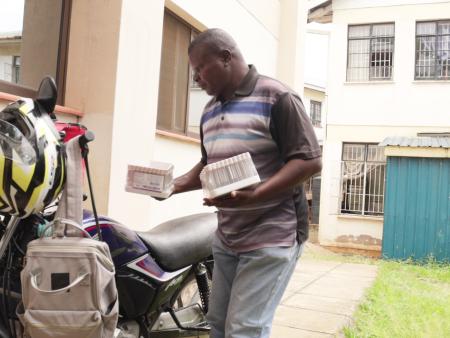
Kenya will also lose another KES 11 billion in other investments that the United States Government set aside for social services for those living with HIV such as education and source of income for adolescents and young women, and continuous professional development for healthcare providers.
Other HIV monies planned
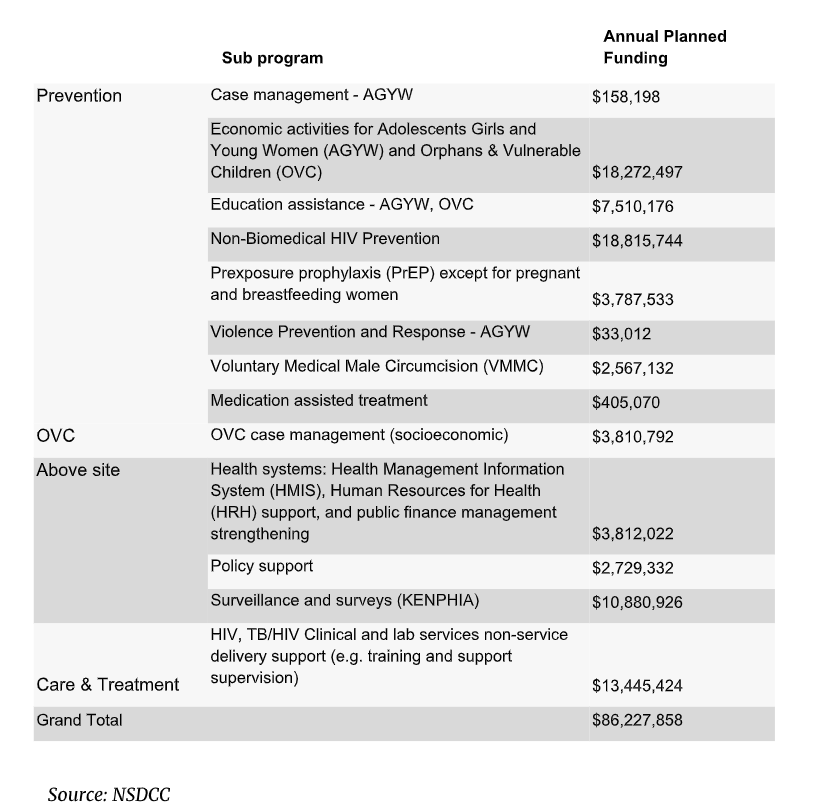
To cover for the likely impact of the gap in funding, Kenya has begun on a path of mitigation in two key ways.
1. Ask the National Treasury for money for immediate medical needs
The Council of Governors, Defrontera learnt, quickly gathered an emergency meeting with all the health executives in Naivasha on Thursday last week. In the meeting, Dr Masha Laiboni, the head of NSDCC, told the county executives that “the essential HIV commodities are at various stages of procurement, with some having already been contracted but no deliveries have been made yet”.
According to the document, the NSDCC will request the National Treasury to create an emergency kitty of KES 15 billion. Of these, KES 4 billion will go to maintaining frontline healthcare workers, while KES 8.8 billion will be used to avert shortages and stock-outs.
Hospitals in Kenya get their medication from the Kenya Medical Supplies Agency (KEMSA). However, PEPFAR supplied the country with medication through a separate channel called the Mission for Essential Drugs and Supplies (MEDS), and the NSDCC will request an additional KES 1.25 billion from the National Treasury to have the medicine that is procured and warehoused by MEDS released.
High-ranking officials at both the Ministry of Health and Council of Governors, who asked that their names not be mentioned as they are not authorised to speak to the press, told Defrontera that there will be deaths before the situation is stable.
One official said, “The deaths? We will not avoid that, I am afraid.”
2. The Ministry to form a crisis committee
The Cabinet Secretary for Health Dr Deborah Barasa, Defrontera has learnt, has formed an Interministerial Crisis Committee, a team that has representatives from the counties and the national Ministry of Health. Dr Ouma Oluga, a member of the committee, gave a curt answer before directing us to speak to the Cabinet Secretary.
Dr Oluga told Defrontera: “The work to fill the gap and manage the situation left by the donors is not a day’s or a week’s work. We are analysing the situation and the potential impact, and then giving the recommendations to the government.”
As the committee is preparing its analysis, the Parliamentary Committee of Health summoned the Cabinet Secretary for Health to a closed-door meeting to be held this week.
The anxiety does not occur in a vacuum. For every $10 that the United States Government gave to Kenya in the past two decades, $6 went to healthcare. HIV and AIDS accounted for nearly half (48%) of the total disbursement.
USAID had three or more projects in 34 out of the 47 counties touching on infectious diseases, maternal, neonatal and child health, education, and environment. Here are some of USAID’s terminated projects that worked on HIV and other medical challenges closely linked to HIV. We will update this list as we confirm the cancellation.
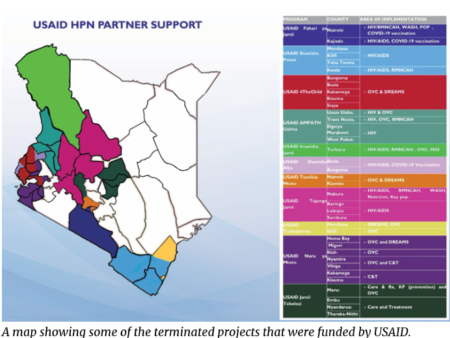
- MOMENTUM Country and Global Leadership program (MCGL) was working in Homa Bay and Vihiga to reduce maternal, newborn, and child deaths.
- MOMENTUM Routine Immunization Transformation and Equity (MRITE) in counties in Western and Nyanza on vaccinations, adolescent and maternal
health.
This story is part of a series on funding cuts in Kenya
Share this feature


