Inside "Protocol" That Helped a Kenyan County Eliminate Maternal Deaths from Postpartum Bleeding
Once one of the deadliest of the 47 counties to give birth in Kenya, Makueni County has eliminated maternal deaths from postpartum bleeding using a WHO-backed protocol, frontline training, and low-cost tools. Here’s how they cracked the code.


VIDEO:
On January 3, 2024, Jackline Kioko, a mother from Kavungi village in Makueni County, went into labour, expecting her fifth child. The fear that gripped the mother of four was beyond normal maternal angst that other women experience. Death, the possibility of it, always hung around Jackline in the labour room, like a cloying scent.
In all four instances, she had battled excessive bleeding, medically known as postpartum haemorrhage (PPH), the deadliest complication in childbirth that the Ministry of Health reports is responsible for two in every five deaths in Kenya.
Between 2020 and 2022, PPH killed nearly 900 of the 2,357 women who died giving birth in health facilities in Kenya, according to a report the Ministry of Health published after investigating every maternal death that occurred in health facilities. The World Health Organization (WHO) estimates that Kenya loses about 7,700 mothers every year, which translates into about 21 deaths every day.
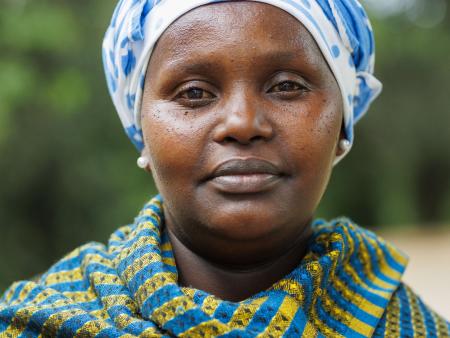
During her previous labour, Jackline says, healthcare workers had “done all they could” to save her life, but it was still a scary experience.
"I got blood transfusions, then I would spend weeks in the hospital afterwards recovering, and I was worried and concerned about what would happen this time around," she told Defrontera.
Wanting to be alert and fit for the potentially dangerous experience of childbirth, Jackline informed her husband that she needed to go to the hospital and that she wanted to walk there instead. With five men and women beside her, Jackline embarked on a two-hour journey, climbing from the valleys of her home to the summit of Kilungu Hill, where the Sub-County Hospital is located.
The decisions in the two-hour window when Jackline first knew she was in labour, and the moment she set foot in Kilungu Sub-County Hospital saved her life, while so many others in Kenya die of excessive bleeding. Time is, literally, a matter of life and death in postpartum haemorrhage. Jackline and her supportive entourage got to Kilungu Sub County Hospital when nurse and midwife Stephen Mulwa had just completed a 10-hour-long night shift and was readying himself to leave the facility. When Jackline mentioned to the nurse that she has had a history of bleeding, nurse Mulwa halted his plans to go home.
“When she said she has had PPH, I was not going to leave even though my shift was over,” nurse Mulwa said.
The nurse sprang into action, assembling all the tools needed to deliver Jackline in the best of worst scenarios.
"I took my PPH kit; it was ready, and because of that history of being blood transfused, we did Group and Cross Match, and we prepared blood. We also had IV fluids, and I prepared an extra team so that in case of bleeding after delivery, we could conquer it," nurse Mulwa said.
Exit “machometre” diagnosis; enter calibrated drapes
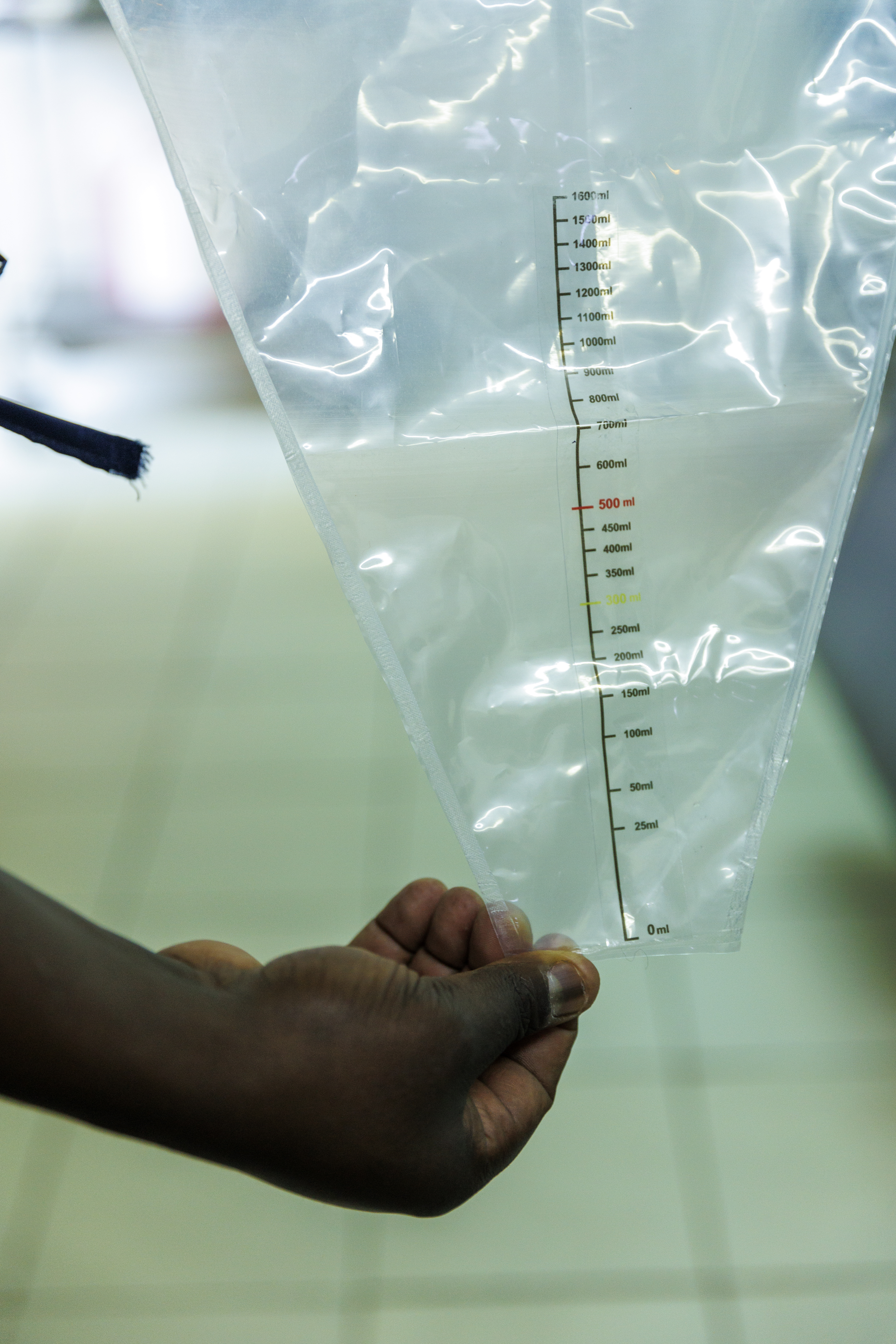
In the delivery room, Stephen also had a delivery table with a drape, a clear plastic-like bedsheet that covers the delivery bed and with pockets to collect blood. The drape had markings that would alert him when Jackline has lost a life-threatening amount of blood – more than half a litre.
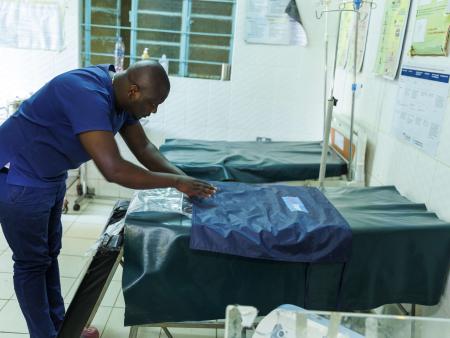
Dr Stephen Mwatha, a physician and an official at Makueni Health Department, told Defrontera that before the use of drapes at the hospital, the healthcare workers would estimate blood loss with “machometre”, a slang the county derived from “macho”, Swahili for eyes.
“The healthcare worker would look at the mess on the floor and say, ‘that looks like PPH’ and that visual estimate was always a great underestimate,” Dr Mwatha said.
Underestimating blood loss means the mother does not get the necessary treatment and eventually dies. Maternal books in Vihiga County Referral Hospital, another health facility that uses the drapes, showed that a healthcare provider had estimated a mother had lost 300 millilitres of blood when the drape showed that the mother had lost nearly a litre of blood. More than half of the women who died of PPH in Kenya were misdiagnosed, according to a recent Ministry of Health report.
The drape is part of a World Health Organization-backed lifesaving bundle of care called E-MOTIVE, an acronym for the medical steps taken to save the life of a mother experiencing PPH: Early detection and trigger activities to save mother as the healthcare worker Massage uterus and applying the Oxytocic medications, like Tranexamic Acid and Intravenous fluids and closely Examining the mother to see if there is a need to escalate her care.
Nurse Mulwa’s elaborate and instinctive to-do list came from extra training that he received when Makueni County got to use the E-MOTIVE bundle. Michael Mwiti, a nurse-midwife and researcher, who led the training of healthcare workers in Makueni, said the trick in E-MOTIVE was to offer all the treatment for PPH together as one, not in sequence, one after the other, as done before.
Mr Mwiti said: “Administering the treatment of PPH in a sequential manner, where a nurse-midwife or clinician gives an intervention and waits to see whether it has had an effect before another intervention is administered — could kill the mother or leave her with permanent complications because every second counts.”
In a study involving over 210,000 women in Kenya, Nigeria, South Africa, and Tanzania, where the drapes and E-MOTIVE were used, it was shown that severe bleeding was reduced by 60%, and the women were less likely to lose their lives.
No-refrigeration medication
Mwiti leads the Kenya arm of Accelerating Measurable Progress and Leveraging Investments for Postpartum Haemorrhage Impact (AMPLI-PPHI), a consortium that works with governments in Africa such as Makueni County to eliminate PPH. Before working in Makueni, as in other parts of Kenya, Michael said that women would die because the condition was not diagnosed, or some effective interventions may not be used at all to save the life of the mother. A survey of hospitals in Kenya and three other countries showed that tranexamic acid, an effective medication that prevents excessive bleeding, was used late and most often as a last resort.
Apart from the diagnosis, nurse Mulwa had in his armoury Heat Stable Carbetocin, a new medication that prevents excessive bleeding but one that does not need refrigeration and acts as fast in just six minutes.
Anxious, Jackline and her family constantly asked nurse Mulwa to check if the health facility had blood in case she needed transfusion.
“I told her she and her child were my primary concern, and I would not let anything happen to her and that the medication Heat Stable Carbetocin was available to ensure that she does not bleed,” the nurse said.
"The nurse injected me with the drug, and this fifth birth was different. I did not believe that I did not bleed. I did not expect it," she says, describing her encounter with Heat Stable Carbetocin, the medicine that healthcare workers baptised “Kausha”, Swahili for drier.
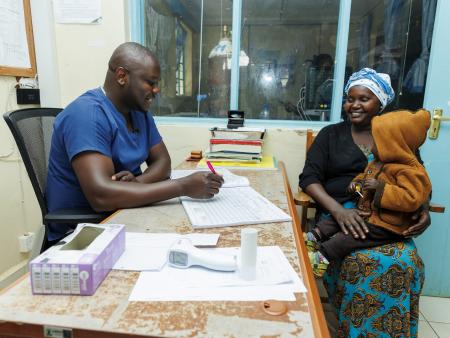
Seeing the evidence, the Kenya Medical Supplies Authority (KEMSA), the government drug dispensing arm, procured 360,000 doses of Carbetocin to make it available in other facilities across the country. Understanding how counties would be cash strapped, consortiums like AMPLI-PPHI and Kenya Obstetrical Gynaecological Society (KOGS) persuaded KEMSA to allow for bulk purchases. That advocacy resulted in the drop in the cost of a dose of the medicine from KES 2,700 ($25) to KES 95 (less than $1).
Taking advantage of the reduced costs and seeing how fewer mothers experiencing PPH would save his government money managing PPH, Makueni governor jumped at the opportunity to purchase the Heat Stable Carbetocin and 11,000 pieces of drapes for all hospitals that offered delivery services. The governor went ahead to take up the role of “PPH champion for Kenya”, mortified when he came across the statistics on death by postpartum haemorrhage.
"I was a little embarrassed because I have been in the public sector leadership for more than 10 years, and I was surprised that the statistics were so high both at a national level and even at Makueni," Mr Kilonzo told Defrontera in an interview.
Due to E-MOTIVE and intense education of the community to appreciate the dangers of PPH, Dr Doris Mbithi, the head of surgery at the Mother and Child Hospital, the county’s referral facility for maternal and newborns, says it has been long since she was called to operate on complications related to PPH. Dr Mbithi, who manages the scarce resources for surgeries, said that fewer PPH complications meant saving lives.
"The numbers of PPH have reduced markedly; so too has the number of mothers we have to take to theatre and do advanced interventions because of PPH, so there is a marked reduction to that end. That is a cost-saving measure because if a mother delivers and they do not develop complications, then it is cheaper for the facility to offer the service," Dr Mbithi told Defrontera.
Since 2022, Makueni County has not recorded a mother's death due to PPH. Health official Dr Mwatha attributes the decline to E-MOTIVE, among other interventions that the county has employed. With PPH accounting for 60% of all previous maternal mortalities in the county, Dr Mwatha said the interventions have seen overall maternal mortality in the county significantly reduce.
Photography: Lameck Ododo
Additional reporting: Anne Mawathe
Share this feature


