Kenya's Health Ministry budget shocker as MPs slash funding by 36% amid USAID exit
The Ministry of Health submitted a budget designed to meet the country’s healthcare needs. However, following two rounds of reviews, the allocation was reduced so drastically that the ministry may receive only a quarter of the requested funds.


Kenya is staring at a debilitating health funding crisis after members of parliament cut the Ministry of Health’s budget by 36% at a time when the nation is facing a massive funding gap left by the withdrawal of U.S. Government funding for key programmes.
Documents obtained by Defrontera show that the Medical Services Principal Secretary had prepared the ministry’s medium-term expenditure plan and projected that it would need at least KES 496.8 billion in the financial year starting 1 July 2025. This figure, Defrontera established, had considered the gap left by the withdrawal of U.S. government funding.
However, the Ministry of Health’s team was treated to a rude shock when they presented this budget to the National Treasury: in the Budget Policy Statement (BPS), the Treasury only allocated $1.57 billion (KES 204.4 billion), which is just 41% of the requirement.
The budget underwent a second round of brutal slashing when the Treasury presented it to the Parliamentary Liaison Committee for review. Chaired by the Deputy Speaker of the National Assembly, Gladys Boss Shollei, the budget was further cut by $564.8 million (KES 73.4 billion), or 36%, leaving the ministry with only $1.008 billion (KES 131 billion). The Ministry of Health now has just a quarter (26.3%) of what it initially requested.
Counties had already started reporting how the previous funding cuts are hampering their ability to offer critical services for infectious diseases like TB and HIV. This shortfall will further exacerbate gaps in care, especially for diseases whose impact is immediate in the absence of treatment, such as malaria, TB, HIV, and maternal care.
Defrontera will report on Kenya’s health financing until the budget is read in June. Subscribe to our newsletter, The Evidence, for updates.
The move to cut funding shocked many in the healthcare sector. Dr. Robert Pukose, former chairperson of the National Assembly Health Committee, told Defrontera, “Budget allocations for the health sector remain inadequate to support the effective implementation of key programmes, particularly with the decline in donor funding."
Appalled by the cuts, the Health Committee—the group through which the Ministry of Health communicates to parliament and distinct from the one chaired by Shollei—pleaded with Parliament to reconsider the drastic reduction of the health budget, given the withdrawal of funding from regular donors.
“GAVI, for instance, will end its support to Kenya by 2028/2029, and so the government ought to increase exchequer funding for vaccine and immunisation programmes, human vaccine production, and health research,” the Health Committee argued.
The Committee also noted that the government had destabilised counties’ ability to provide health services through the defunct National Health Insurance Fund (NHIF), which owes healthcare providers an estimated $238 million (KES 30.9 billion).
The National Treasury and the Shollei-led team cut the health budgets, as they made these adjustments after two critical meetings. The first was a presentation by the 50-person committee formed by the government to analyse the impact of funding cuts. The team, chaired by Dr. Fredrick Ouma Oluga—currently the Director of Medical Services at the Ministry of Health—stated in their report, “Of the KES 80.5 billion required for Kenya’s national health programmes, approximately KES 24.9 billion is provided by the U.S. Government for disease-specific programmes.”
The report seen by Defrontera listed the departments that would be most affected by the funding cuts.
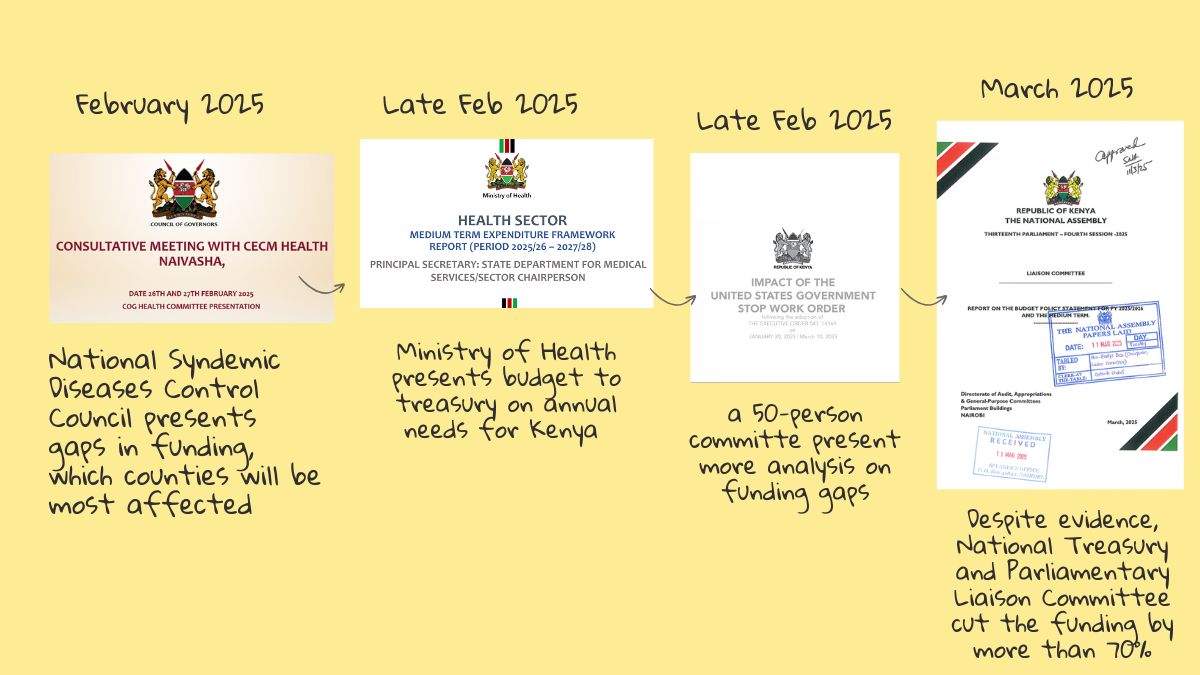
The second instance was when the former Principal Secretary for Medical Services, Harry Kimtai, presented the team with a detailed, listicle-style document outlining what is needed annually for each function at the Ministry of Health.
“We are advocating increased budgetary allocations and ring-fenced funding to reduce donor dependency, bridge resource gaps in essential health commodities, and ensure the effective implementation of health programmes and projects,” said Kimtai.
In the list, the Ministry of Health requested KES 68 billion for primary health care, which would include services offered at the community level, dispensaries, and health centres, including health education. The former PS Kimtai also requested nearly KES 3 billion for blood transfusion services. Billions more were requested to provide care and purchase medication for malaria, TB, and HIV.
Share this feature


