Kenya’s Health Ministry Closed 998 Health Facilities. Defrontera Visited One — It’s Still Open
Regulators ordered 6 per cent of the nation's health facilities shut for alleged “non-compliance”. There was no inspection or visits to the facilities. Many continue to operate, raising questions over how closures were determined and implemented.


It’s difficult to miss it. Mwiki Road Hospital’s flashing lights announce its presence on a tower that stands out in the crowded, dust-choked Sunton estate in Kasarani, one of Nairobi’s most populous sub-counties.
The facility remains wide open, operating 24 hours a day—despite being among the 998 health facilities that the Kenya Medical Practitioners and Dentists Council (KMPDC) recently ordered closed for “non-compliance with set standards”. According to KMPDC’s Chief Executive Officer, Dr David Kariuki, non-compliance included operating “without valid licences and unregistered premises”.
The 998 facilities constitute 6 per cent of the 16,265 registered healthcare facilities in Kenya today, according to the Ministry of Health. Nearly half of all facilities (7,941) are privately owned, while four in ten (6,930) are public hospitals run by the government. The remainder are mission and non-profit facilities.
When Defrontera visited the Mwiki Road Hospital, a day after the notice was issued, it was business as usual. The receptionist at the private health facility was tidying up consultation rooms after a night shift, preparing for the morning patients. Soon after, patients began trickling in for a variety of services: outpatient care, pharmacy, minor surgeries, family planning, specialist clinics, and mother-and-child health, including antenatal care.
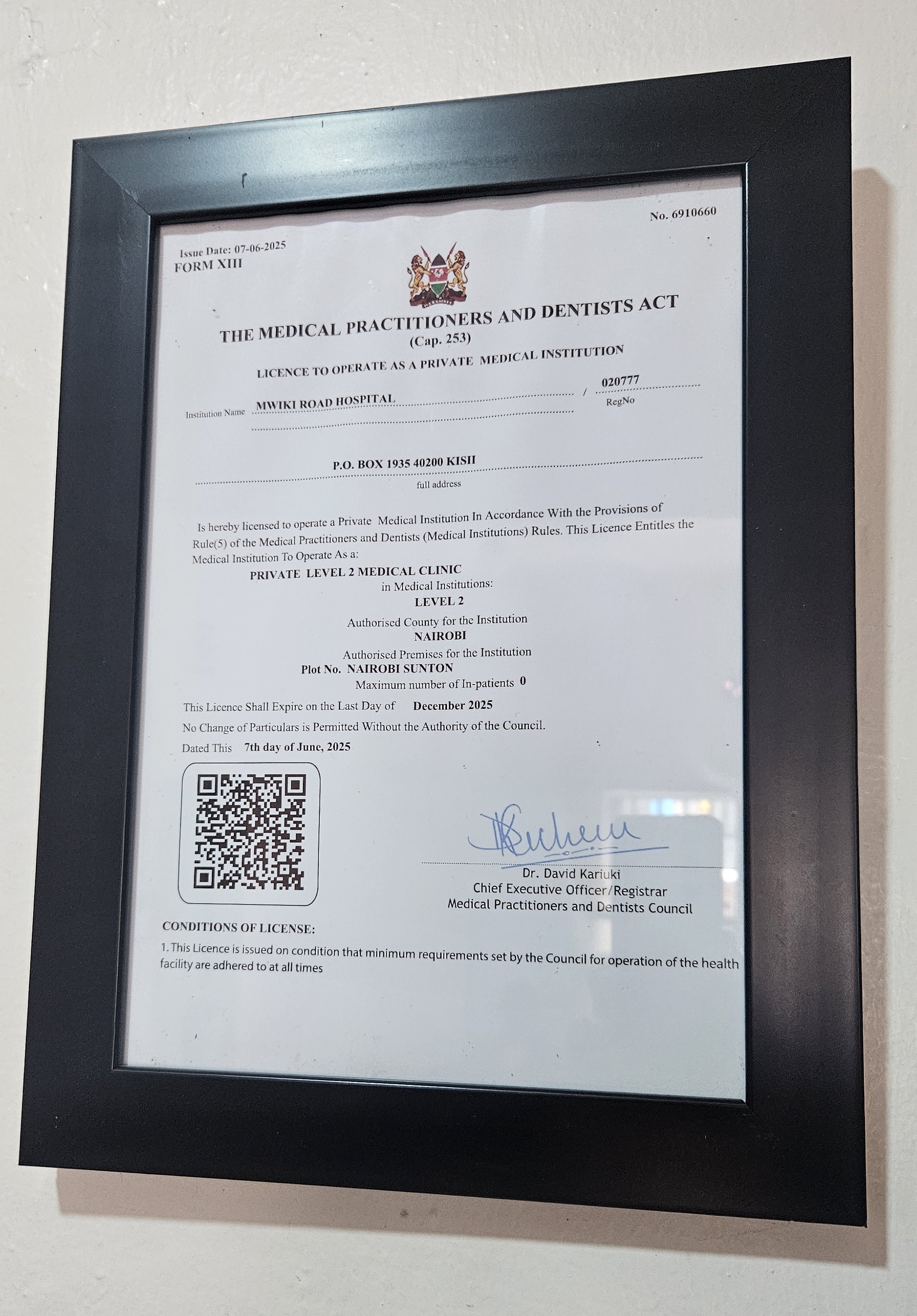
The hospital’s management said it was shocked by the 29 August KMPDC notice. An attendant at the facility who only wanted to be identified as Charles told Defrontera he had neither seen the gazette notice ordering the facility shut nor had the hospital received any communication or inspection visit from KMPDC. Charles produced the facility’s registration licence—complete with a valid QR code redirecting to KMPDC’s own online list of licensed facilities. Issued on 6 July 2025, the licence is valid until 2 December 2025 under registration number 020777.
“We have a valid licence as far as I know. This gazette notice must either be fake or a mistake. Besides, no KMPDC official has ever inspected us or served a closure notice. I have CCTV footage to prove this,” Charles said.
Dr Kariuki did not respond to Defrontera’s request for confirmation of the Kasarani facility’s closure and reasons for KMPDC’s decision. On social media platform X, Dr Kariuki referenced a previous inspection of 288 facilities in Nairobi, which resulted in 158 closures. 25 downgrades, and 105 facilities reportedly retained at their level despite “operating below required standards”.
“Some lacked critical infrastructure such as pharmacies, maternity wings, and laboratories. Others faced sanitation issues and inadequate waste disposal, posing a direct threat to patient health,” Dr Kariuki wrote on X.
But questions, like the ones fielded by Charles at Kasarani, raise legitimate concerns. The council announced the closure of more than 900 facilities. If they did not make actual visits to entities that hold valid licences, that raises concerns about how compliance decisions were reached.
The Ministry of Health of Kenya has an elaborate classification system—level 1, 2, 3A, 3B, 3C, 4A, 4B, 4C, 5, 6A and 6B—detailing what each tier must provide. To close a facility, according to KMPDC’s guidelines, the council and other regulators (like the Nursing Council of Kenya and the Clinical Officers Council) are expected to check requirements such as staffing levels, services, and equipment. For instance, KMPDC’s checklist for Level 3B includes the availability of doctors, nurses, clinical officers, and a specialist for each service offered; a dental unit requires a dentist, and an X-ray room a radiographer.
Health Cabinet Secretary Aden Duale appeared to link the closures to graft at the Social Health Authority (SHA), the restructured national health insurance body. He said facilities were shut “due to violations such as substandard operations, unlicensed staff, and inadequate infrastructure jeopardising patient health”—and accused rogue hospitals of syphoning billions of shillings from SHA through fictitious claims.
Under the Medical Practitioners and Dentists Act, operating a health institution without a KMPDC licence attracts a fine of up to Ksh 10 million, five years’ imprisonment, or both. Practising without a licence carries a penalty of up to Ksh 5 million or five years in jail, or both. Despite this, many facilities that were listed as closed remain fully operational. KMPDC has yet to explain how it intends to enforce compliance—or protect patients from potentially unsafe services.
Editing and Structure: Prof Peter Kimani
Videos and Graphics: Michael Omondi
Share this feature