New Gates-backed funding targets gaps in childhood diarrhoeal death estimates
To win up to US$1.5 million (about KES 194 million), experts say applicants should prioritise existing data to correct for under-reporting, identify the pathogens driving diarrhoeal deaths, and show governments where resources are needed most


Throughout his career, microbiologist Professor Sam Kariuki has explored many fields, but he has never taken his eye off one: the microorganisms that live in the intestines and cause diarrhoea.
Prof Kariuki and his colleagues in Kenya have generated a lot of research about diarrhoeal diseases: which pathogens cause severe illness in different parts of the country and how some have developed resistance to medicines designed to treat them. Their research has helped Kenya's Ministry of Health respond to outbreaks and prevent deaths from diseases such as cholera.
Yet despite decades of research, diarrhoeal disease remains a leading cause of death among children under five, accounting for an estimated 13% of deaths in that age group globally. One reason these deaths persist is that researchers still lack reliable estimates of which pathogens are responsible for the largest share of deaths in their countries.
“From the pilot studies we conduct, I would put diarrhoeal diseases probably among the top three causes of morbidity and mortality. But what is the true burden? Nobody can say for sure,” Prof Kariuki told Defrontera.
Grand Challenges, a programme funded by the Gates Foundation, is offering up to US$1.5 million (about KES 194 million) per project for organisations that can produce better estimates of diarrhoeal mortality among children under five in low- and middle-income countries. The call acknowledges that many countries still lack reliable estimates of which diarrhoeal pathogens kill children, particularly where deaths occur outside health facilities and among populations with limited access to healthcare.
“These are diseases of poverty, where you find low economic empowerment, people without clean water, hygiene and sanitation, and there's a lot of over-the-counter treatment, and the only way a child will probably proceed to a healthcare setting is if they become dehydrated and the disease proves more severe,” Prof Kariuki said.
Missing cases, missing pathogens
In addition to barriers to accessing healthcare, the available figures are likely to underestimate the true burden of diarrhoeal disease because many health facilities lack the laboratory capacity needed to identify the pathogens responsible and determine which strains are circulating.
Dr Innocent Kamara Tumwebaze, an Associate Research Scientist in the Urbanisation and Wellbeing Unit at the African Population and Health Research Center (APHRC), said lower-level facilities in Kenya's health system, which care for a lot of children with diarrhoeal disease, often lack even basic diagnostic capacity. National surveys such as the Kenya Demographic and Health Survey (KDHS) provide important information, but they rely heavily on self-reported illness and cannot capture every case.
“Because of these factors, we may end up missing as much as 60% of diarrhoeal disease cases, and there is also limited population-based surveillance coverage in slums and informal settlements where there are no systems to track disease trends,” Dr Tumwebaze said.
Researchers say another challenge is that current surveillance systems often overlook animal-to-human transmission pathways.
“We rarely think in our communities that animal faeces can be just as dangerous as human faeces, and cats, dogs and chickens all carry pathogens that can cause diarrhoea, but they are often missed because they have not traditionally been the focus of public health policies,” Dr Tumwebaze explained.
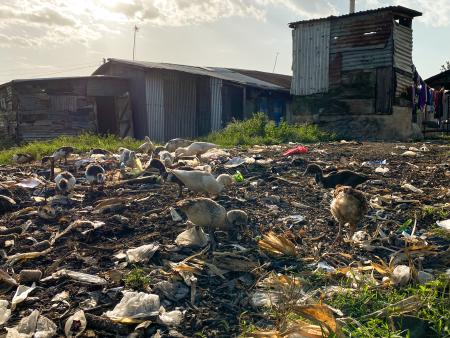
A review of 29 studies found that roughly seven in ten reported a link between exposure to domestic animals and diarrhoeal illness. People exposed to poultry were nearly three times more likely to develop Campylobacter infections, one of the bacterial causes of diarrhoea.
Missing large numbers of cases inevitably affects the quality of disease estimates, and the problem extends far beyond Kenya. Hmwe Kyu, Associate Professor of Health Metrics Sciences at the University of Washington School of Medicine, said uncertainty intervals for diarrhoeal mortality in sub-Saharan Africa are roughly twice as wide as those in high-income regions.
In a 2024 study, Kyu and colleagues at the Institute for Health Metrics and Evaluation (IHME) estimated that diarrhoeal diseases caused 1.17 million deaths globally in 2021. While the analysis identified countries with particularly high mortality burdens (South Sudan, the Central African Republic, Chad, Somalia, Lesotho, Niger and Eritrea), the researchers noted major limitations in the data available from sub-Saharan Africa.
“The wideness of these intervals varies across locations; in areas and years where local data are sparse, or sampling errors are substantial, the resulting estimates carry high levels of uncertainty,” Dr Kyu wrote in an email to Defrontera.
What the grant offers
The Grand Challenges call seeks country-level estimates of diarrhoeal deaths and illnesses and asks applicants to present their findings in three ways: the total number of children under five who die from diarrhoea, the proportion of deaths and severe illness caused by specific pathogens, and the incidence rates showing how common these outcomes are.
Where data are unavailable for 2025, applicants may use accepted statistical methods to project estimates from existing datasets. The call also requires applicants to communicate uncertainty. Rather than presenting a single number, researchers are expected to provide a range such as an estimate of 10,000 deaths might be reported alongside an uncertainty interval showing the likely range is between 9,000 and 12,000 deaths. Applications are due on 16 June, and funded projects may run for up to two years.
The call requires estimates for eight pathogens: rotavirus, Shigella, adenovirus 40/41, norovirus GII, ST-ETEC, endemic cholera, Cryptosporidium and Campylobacter. However, applicants may also analyse additional pathogens, including Enteropathogenic Escherichia coli (EPEC), Salmonella, Giardia and intestinal worms, but these cannot replace the required pathogen list.
The winning profile
Comprehensive surveillance systems that collect primary and complete data require significant investment in personnel and laboratory infrastructure. Many such activities in African countries have historically relied on external donor support, including USAID. Rather than funding new surveillance programmes, however, the Grand Challenges call encourages researchers to make better use of existing epidemiological, surveillance and laboratory data.
The strongest applicants are likely to be organisations that can use existing datasets to build transparent models that correct for under-reporting and weak surveillance systems. The grant will not fund new surveillance programmes, intervention studies or projects based primarily on literature reviews.
“The Foundation is particularly interested in proposals that demonstrate credible alternatives or complements to existing estimates (e.g. IHME Global Burden of Disease),” the call states.
The grant also favours teams that can translate estimates into evidence that is useful for policymaking, a critical consideration in countries such as Kenya where public health spending decisions increasingly require robust data.
“Is the highest burden within highly populated urban and semi-urban areas? Resource allocation can be justified by knowing where the biggest burden of diarrhoeal diseases is and what must be done there,” Prof Kariuki said.
One example comes from cholera. In 2022, researcher Dr Catherine Kiama mapped cholera hotspots in Kenya. When an outbreak occurred later that year, the government deployed nearly two million oral cholera vaccine doses to the high-risk areas identified by the analysis.
Rotavirus, the pathogen that all three researchers highlighted as a major concern, already has a vaccine. Yet not all children get vaccinated, leaving them vulnerable, and many will eventually need treatment. While oral rehydration therapy remains highly effective at preventing deaths from dehydration, identifying the specific pathogens responsible for disease is important because different pathogens may require different prevention, treatment and control strategies.
With antimicrobial resistance continuing to rise globally and drug-resistant strains of pathogens such as Shigella already reported in parts of Kenya, better burden estimates could help identify where antimicrobial-resistant diarrhoeal pathogens pose the greatest threat.
Sources
Typhoid Salmonella disease in Mukuru informal settlement, Nairobi Kenya; - carriage, diversity, and antimicrobial resistant genes
Antimicrobial Resistance in Endemic Enteric Infections in Kenya and the Region, - and Efforts Toward Addressing the Challenges
UNICEF data on - child mortality in Kenya.
Grand Challenges Request for Proposals on - "Estimating the Global Burden of Diarrheal Diseases"
Human diarrhea infections associated with domestic animal husbandry: - a systematic review and meta-analysis
Global, regional, and national age-sex-specific burden of diarrhoeal diseases, their risk factors, and aetiologies, 1990–2021, for 204 countries and territories: - a systematic analysis for the Global Burden of Disease Study 2021
Now is the time to invest - in locally-owned health data systems
Mapping of cholera hotspots in Kenya using epidemiologic and water, sanitation, and hygiene (WASH) indicators as part of Kenya’s new 2022–2030 cholera elimination plan - Kenya’s new 2022–2030 cholera elimination plan
The incidence and antimicrobial resistance of Shigella-attributable diarrhoea in young children in low-income and middle-income countries from the multicountry Enterics for Global Health (EFGH) Shigella Surveillance Study: - a prospective, facility-based hybrid surveillance study
Share this feature