Once a Model, Machakos Hospital Now Exposes Gaps in Kenya’s Maternal Healthcare
Once regarded as a frontrunner in maternal healthcare, boasting cutting-edge medical equipment and ambulances screeching for attention, Machakos County is on the wane. Maternal mortality is on the rise, many of the ambulances are rotting away in parking yards, the equipment is broken, and desperate patients are crying out for help.


She lay listless on a small hospital bed with a thin mattress, her back turned to us, as though seeking to shield herself from our gaze or the fresh memories of her botched journey into motherhood. It had started four days earlier when Gladys Wanza*, 18, went into labour.
She left her home in Kathoma village, a hilly hamlet in Mwala, in Machakos County, for the nearest hospital, Mbiuni Health Centre, a Level 3 facility offering basic healthcare. Mbiuni is about three hours away on foot, or an hour by motorbike—boda boda, as commonly known in Kenya—if one has Sh300 to spare for the fare.
“There are no vehicles serving our village,” explained Elizabeth Mueni*, Wanza’s elder sister, 25, and a mother of two. “We prefer boda bodas, as they can ride through areas without roads. But when one is not sick, we simply walk.”
Mueni accompanied her sister on the uncomfortable ride, arriving at Mbiuni later that evening. A medic examined Wanza and made a grim diagnosis: she was bleeding and needed to be transferred to Machakos Level Five Hospital—the largest and best-equipped facility in the county, over 60 kilometres away.
The two sisters were fortunate on two fronts: an ambulance was made available immediately, and a doctor was on hand to examine Wanza upon arrival. The journey through the undulating terrain and serpentine coils took two hours. By then, Wanza had soaked through four blood-soaked pads, jeopardising her unborn baby. When she delivered, it was a stillbirth. The following day brought fresh challenges. Nursing staff at the hospital went on strike, as did all the nurses within the county, over remuneration and promotion.
A strike, a diagnosis, a bill
The technical term for Wanza’s condition, as Defrontera gleaned from her discharge sheet, is placenta praevia, a complication that emerges when the placenta attaches to the lower part of the uterus, causing painless vaginal bleeding. It is easy to diagnose using ultrasound during prenatal clinics, but Wanza, who left school after her Class 8 exams, had attended none.
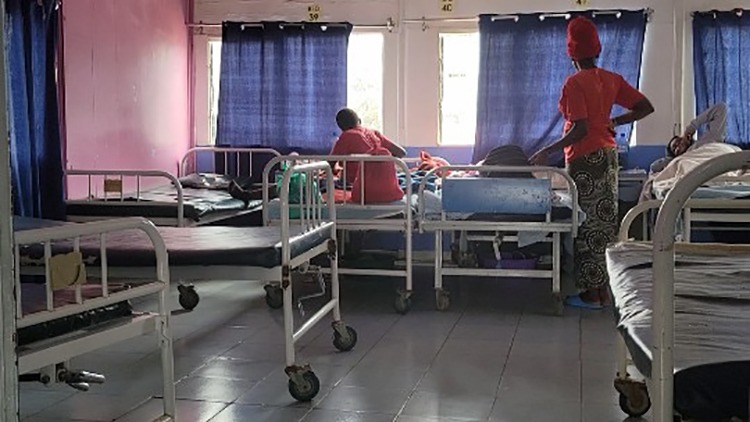
When Defrontera visited Machakos Hospital, Wanza was pensive. She had lost her baby, but her frail body was on the mend. She was overjoyed to learn she had been discharged, though there was a fresh hurdle: a bill of Sh15,500.
“All these are mothers who have been discharged but can’t leave due to bills,” an attendant at the billing office said, waving at a pile of files on her desk. It is a problem that even the county governor, Wavinya Ndeti, acknowledged last year and promised to address.
Mueni told Defrontera she had unsuccessfully pleaded for Wanza’s release, explaining to a social worker that their mother, a subsistence farmer widowed eight years ago, was in no position to raise Sh7,000—half the total bill. Wanza’s mother had registered for the new national insurance – Social Health Insurance Fund (SHIF) – but her subscription was not up to date. In any case, Wanza could not utilise her mother’s SHIF because she is over 18, and most private health insurance covers extend to dependants under the age of 24.
When Mueni checked the fees on our day of visit, the tab had climbed slightly to Sh17,000, and it would keep rising for as long as Wanza remained in hospital. With a skeletal staff, the maternity ward was almost empty, as relatives transferred their patients to other facilities. The few nurses on duty sat chatting or scrolling through their phones, anxiously waiting to sign off and leave. It was a luxury Wanza and Mueni could not afford.
The paradox of Universal Health Care
Ironically, it was on that very day that President William Ruto assured the nation that the Universal Health Care (UHC) programme was off to a great start and that no Kenyan would be charged for seeking treatment at a public health facility.
“Let me state here”, President Ruto said at the devolution conference in Homa Bay County, “that we have made provisions in the budget of Sh21 billion to make sure that treatment and medicine at Level 2, at our dispensaries, at our health centres, at our sub-county hospitals, all the way to Level 4 outpatient facilities, is paid for fully by the Government of Kenya.”
Here is what is concerned with President Ruto's statement. In Kenya’s tiered health system, the Universal Health Care (UHC) programme promises free treatment, but this is limited mainly to Levels 2 to 4. Level 2 facilities are dispensaries offering basic outpatient care, while Level 3 facilities are health centres providing primary care and minor emergency services. Level 4 comprises sub-county hospitals, which handle outpatient and some inpatient services. Framed in this way, the UHC policy effectively locks out patients who require specialist care and advanced equipment at Level 5 referral hospitals, such as Machakos.
Wanza’s experience, before, during, and after her botched journey into motherhood, represents a larger crisis in public healthcare. The distinctions between outpatient and inpatient care, as well as between different tiers of hospitals, are some of the grey areas that need clarifying—especially since those who make it to Level 5 hospitals often require complex interventions by medical specialists only found there.
Collapsing foundations in Machakos
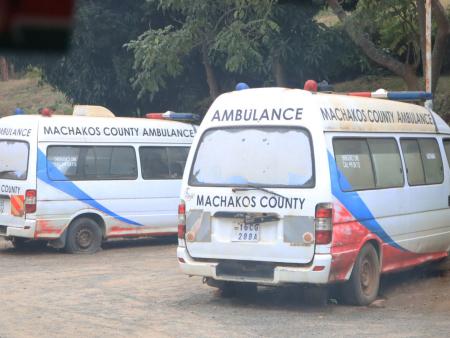
Machakos County was once held up as a model in healthcare provision, outperforming Kenya on most indicators between 2018 and 2022. Now, it appears to have been founded on quicksand, collapsing in a morass of inefficiency and ineptitude. Many of the 70 ambulances procured in 2015 for the county’s 40 wards are now rotting away in parking lots, an outward sign of deeper decay. Defrontera counted five grounded ambulances at both Machakos Hospital and the nearby Kathiani sub-county hospital. More vehicles, including one acquired through the Facility Improvement Fund of the Ministry of Health, were grounded at Machakos.
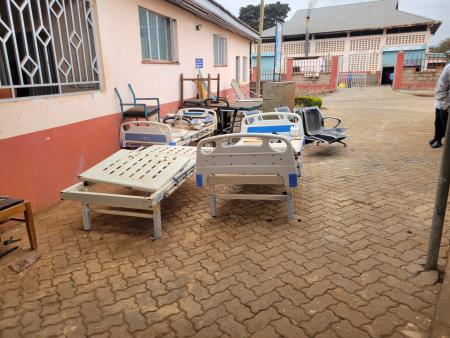
A source disclosed that the MRI equipment acquired through the equipment leasing programme initiated by the Uhuru Kenyatta administration is now out of repair, forcing patients to seek services at private facilities surrounding the hospital. The maintenance workshop was littered with broken equipment. “We were told new equipment would be delivered under a new programme, so we’ll just wait and see,” she said.
Some three weeks ago, about 150 lab technicians from the county staged protests over a Collective Bargaining Agreement (CBA) that has not been honoured. With human resources on strike indefinitely and many vehicles grounded, insiders say the mess inside the hospital is even worse.
The result of this crumbling system is that maternal mortality in Machakos has climbed to 398 deaths per 100,000 live births, higher than the national 355. The neonatal mortality—death of children below 28 days—and under-five have increased as well. Wanza is the latest addition to this list, and, unless something changes soon, she will not be the last.
*Names have been changed to protect patient identities.
Share this feature


