The Superbugs Chaser: Tracing antibiotic use in Kenya’s Largest Slum
In Kibera, public health researcher Sylvia Omulo is tracking how everyday antibiotic use and contaminated environments are fueling the spread of drug-resistant bacteria.


KIBERA, NAIROBI — She walks down an open sewer, holding a blue lab specimen transport box, her straight-cut trousers slipped inside her black rubber boots. Two similarly attired scientists on her team snap on gloves and masks and stand beside the open sewer running through a tight street in Kibera slum in Kenya’s capital. The scientists open small transparent bags and collect water samples from the sewer. She turns her back to the open sewer. “We have found that a lot of people within this community carry resistant bugs,” she says.
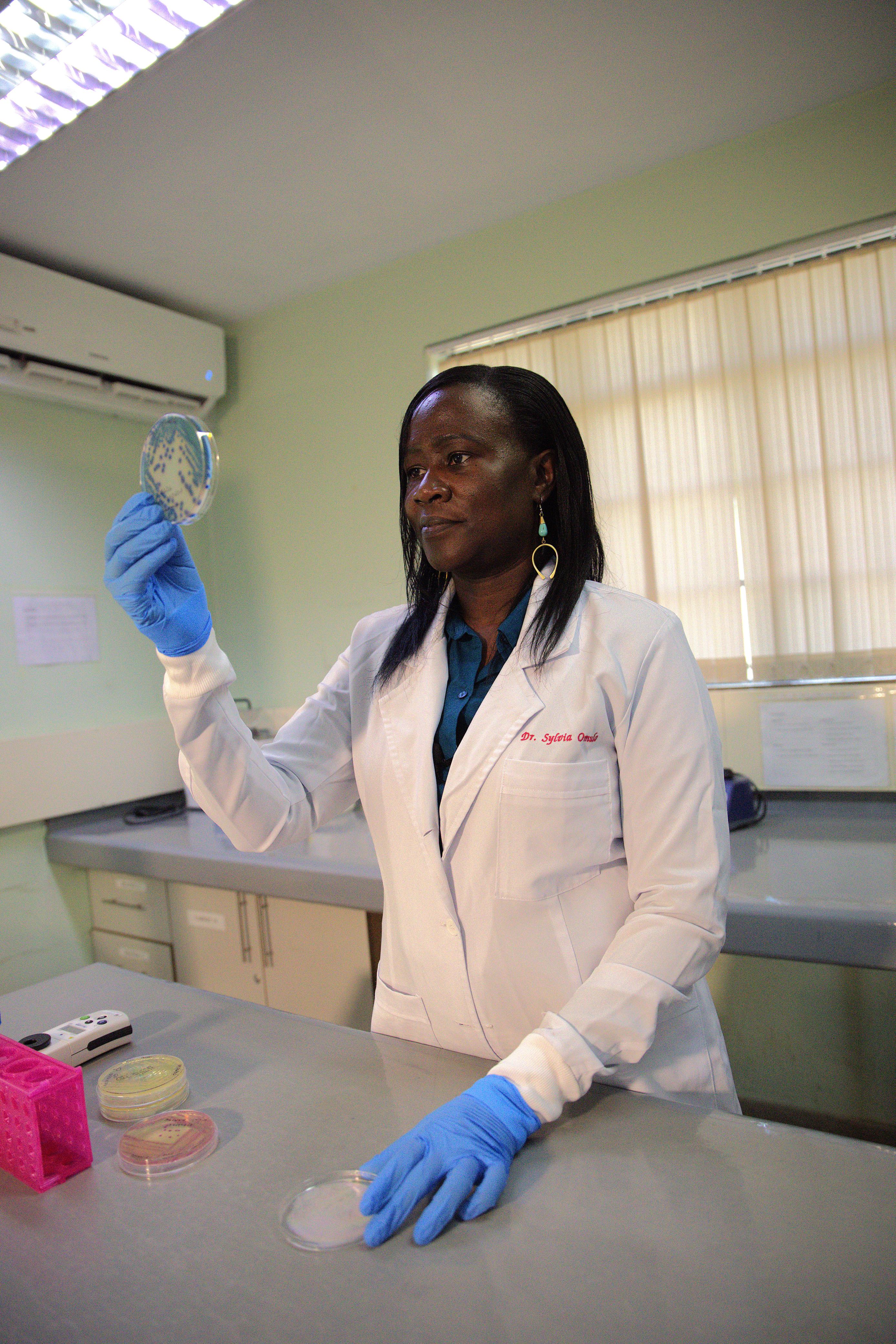
Sylvia Omulo and her team have been chasing superbugs—dangerous bacteria that have developed antibiotic resistance—all day in Kibera. An assistant professor at Washington State University (WSU), she leads the antimicrobial resistance (AMR) project at WSU's Kenya office. Since 2021, her team has been trying to tackle one of the country’s and the world’s most urgent public health threats: pathogens that have evolved to outsmart the drugs designed to stop them.
Antibiotic-resistant infections alone are projected to kill more than 39 million people over the next 25 years globally, according to a study in The Lancet. In Kenya, an estimated 30,000 people die each year after bacteria that cause their illness become resistant to treatment, leaving infections difficult or impossible to cure.
In the Kibera slum, Africa’s largest slum with over 1 million residents, Omulo and her team are studying patterns of antibiotic use in the community in the hope of identifying where overuse may be driving resistance. “Understanding what the drivers are at the community level is important—not just quantifying what is in the community and how much of it is circulating, but what is really driving the emergence of antibiotic resistance,” says Omulo.
Omulo’s approach reflects a broader shift in AMR research away from studying drug-resistant pathogens only in hospitals to understanding how they emerge and circulate in everyday environments. But her career, she says, has followed a series of detours, where research questions evolved, and projects shifted direction as new developments emerged.
Early curiosity about science
The curiosity that drives Omulo’s research began in her early childhood. As a child, Omulo wandered into her mother’s library and picked up a book—the 1989 edition of Mutation by Robin Cook, a medical thriller about a doctor who genetically engineers his son to become both brilliant and dangerous. At first, it was the cover that caught her eye: a child suspended inside a test tube. But as she read, she became fascinated by the scientific ideas in the story—particularly how the fictional gynaecologist engineered genetically enhanced children. “After reading that book, at about nine, I knew I wanted to become an inventor,” says Omulo.
After completing an undergraduate degree in biomedical sciences at Egerton University in Kenya, Omulo received a World Bank scholarship for her master’s studies at the University of Leeds in the United Kingdom. She returned home soon after graduating to work with the virologist Kariuki Njenga in the then CDC-funded Emerging Infections Programme laboratories at the Kenya Medical Research Institute (KEMRI). Barely a month into the job, Omulo was thrust into the field: she joined the team that responded to the 2006–2007 Rift Valley Fever outbreak in Garissa, northern Kenya. The experience, says Omulo, exposed her to the fast-moving world of viral outbreaks and responses.
Her focus on AMR research began during her doctoral studies at WSU. Omulo naturally gravitated towards virology, but Njenga suggested a different path: study bacteria instead—specifically, the growing problem of AMR. At the time, the field in Kenya was still small.
“Then there were only two experts known in this area, Professors Sam Kariuki and Gunturu Revathi,” Omulo recalls. “But Prof Njenga told me that antimicrobial resistance would be a major public health issue, and if I studied it, I would be a specialist when the country needed one.”
Tracing antibiotic use
Switching fields meant learning new pathogens and asking a new set of scientific questions, says Omulo. She immersed herself in the emerging literature on AMR, publishing her first review in 2015. The work nudged her research away from hospital wards and into the community, where patterns of antibiotic use often begin.
In a 2023 study in Kibera, Omulo brought together specialists from other disciplines—including anthropologists—to help interpret the patterns emerging from the samples her team collected, and to understand how everyday behaviours in the community might be shaping those patterns of resistance. The researchers collected samples from 132 mothers and their infants. What they found was striking: babies as young as 28 days old were already carrying drug-resistant bacteria.
“Our environmental studies suggest this is a heavily contaminated setting where these bacteria are constantly circulating,” Omulo says. “A mother may pick them up in the course of everyday activities like washing, touching her breast before breastfeeding. And the infant can begin acquiring these organisms very early in life.”
The team also traced how antibiotics were being used in the community. Two oral drugs—amoxicillin and metronidazole—were by far the most common. In contrast, the injectable antibiotics ceftriaxone and gentamicin were used more frequently in clinical settings.
The distinction, Omulo says, points to a more targeted challenge. “One key finding was that the problem is not all antibiotics,” she says. “It’s a small number that is widely used in community settings.”
Sources
Global burden of bacterial antimicrobial resistance 1990–2021: a systematic analysis with forecasts to 2050 - a systematic analysis with forecasts to 2050.
Virologist Prof Kariuki Njenga's - Profile on Nature Magazine.
CDC's account of - 2006-2007 Rift Valley Fever outbreak
A review of 40 years of enteric antimicrobial resistance - research in Eastern Africa: what can be done better?
Share this feature
