In Turkana, livestock and vaccines walk hand in hand
In Turkana, where vaccination rates have plummeted to 29%, a unique initiative is bringing life-saving vaccines to children—by combining human and animal health services in one clinic.


The people of Turkana, a county in northern Kenya, deeply value their livestock. They will do anything to protect their cattle, goats, camels and sheep from disease and the consequences of drought.
Understanding this cultural dynamic, the county’s Health Department is now running joint clinics — for both people and livestock. Only a third (29%) of children in Turkana are fully vaccinated, well below 80%, the threshold recommended by the World Health Organization (WHO). As a result, deadly viruses such as polio and measles are sweeping through the region, with the county currently battling new outbreaks of both diseases.
“At the clinic, men bring their cattle, goats, camels and sheep for veterinary care, as these are their livelihoods — but they also come with their children to be vaccinated by human doctors,” said Dr Joseph Epem, Turkana’s County Health Minister.
Dr Epem explained that the clinic is part of an initiative called Kimormor — Turkana for “all together”. Supported by the remaining funds from the United States Agency for International Development (USAID), Kimormor offers combined human and veterinary health services to nomadic communities at a single point of contact. The minister said the department has not conducted a formal analysis, but “the utilisation of the vaccines in the last year points to an increase in the uptake of childhood vaccines in Turkana.”
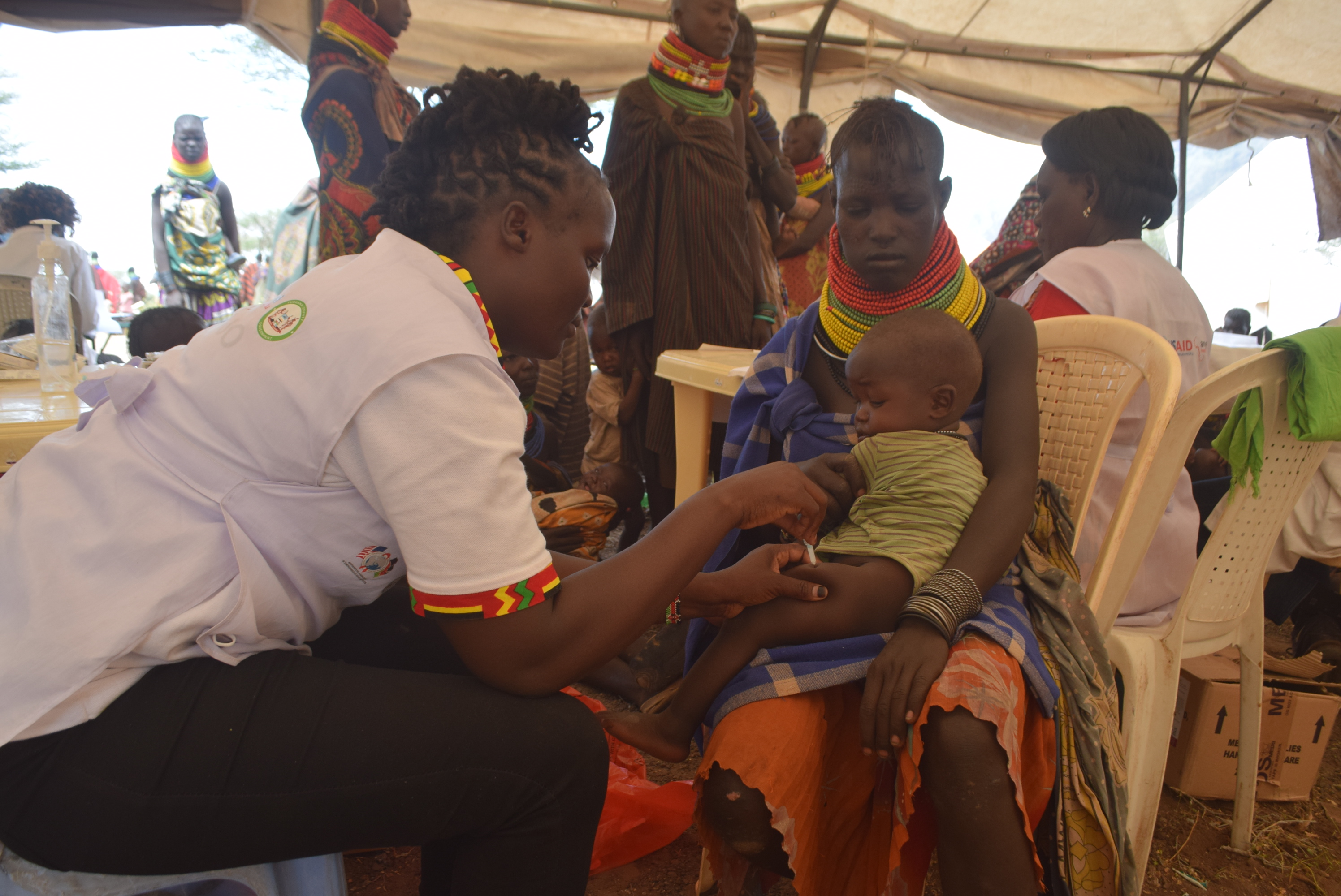
In remote Puch, Turkana County, Kenya, a health worker vaccinates a child during the Kimormor outreach — where children and livestock receive vaccines — as part of the county’s efforts to close the immunisation gap in underserved communities in May 2025. PHOTO/Hesborn Etyang
Turkana’s vaccination rates have dropped by more than half over the past decade. According to the 2014 Demographic Health Survey, Turkana’s full childhood vaccination coverage stood at 62%. The 2022 survey put it at just 29%. The solution, Dr Epem says, requires more than simply providing vaccines.
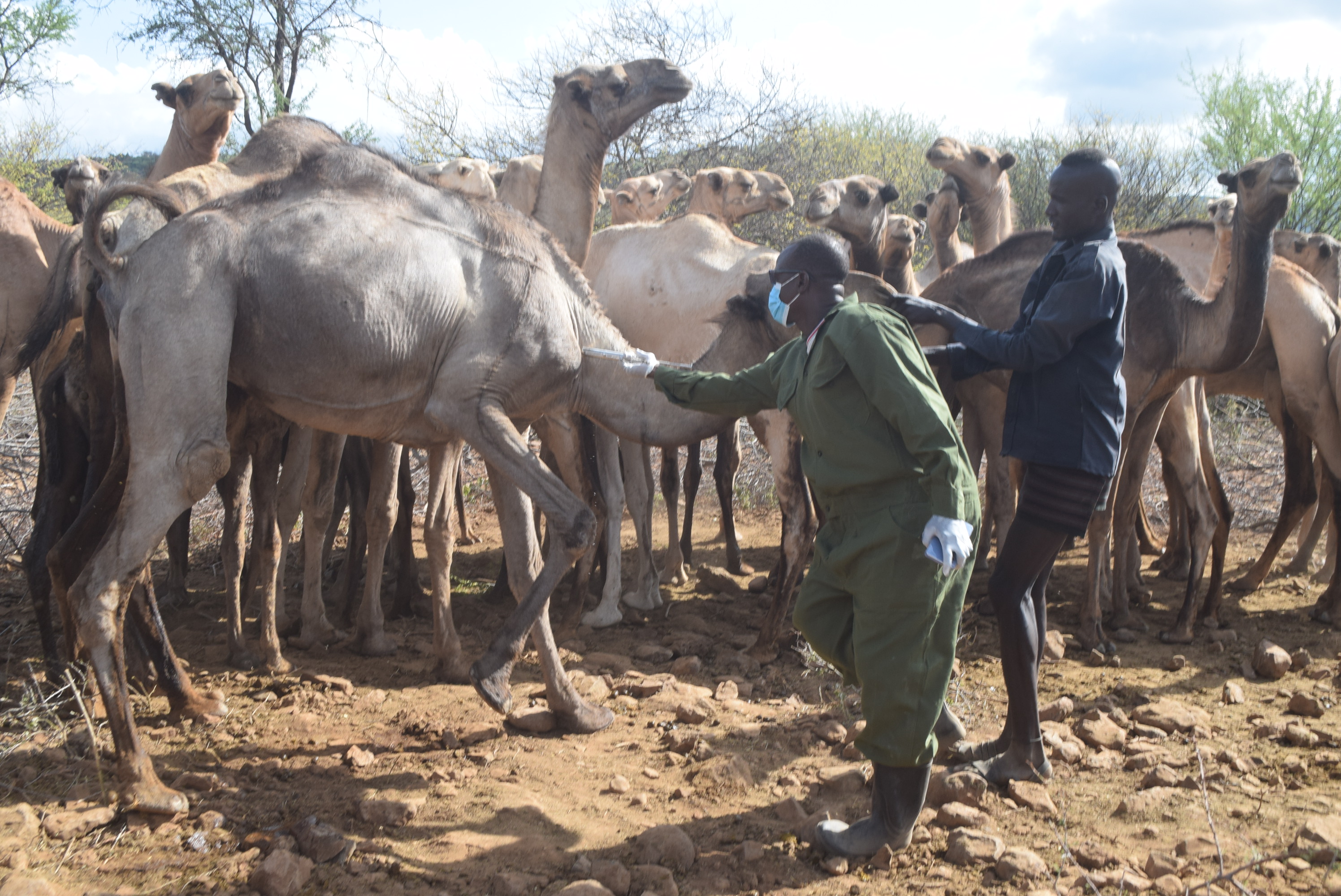
Naukot Lokwale, a mother of seven, endured the scorching sun and walked for hours with her youngest child to Puch — one of the outreach sites providing vaccines. “It didn’t matter that my son was getting his injection next to cattle being treated with huge veterinary needles,” she said.
Naukot doesn’t know exactly how far she walked — only that she had been on the road for at least two hours, determined to protect her toddler from diseases that vaccines can prevent. While she does not specify which illnesses her older children suffered from, Turkana has recorded nearly 2,000 measles cases since 2023, according to county health officials.
Many parents and guardians like Naukot are aware of the value of vaccination and actively seek it. The county, in turn, is striving to meet the demand. But multiple challenges stand in the way. Turkana is Kenya’s largest county, spanning over 71,000 square kilometres of dry, arid land, with health facilities few and far between.
“Under normal circumstances, I would walk up to 11 kilometres to the next village, Lokwatuba, to access health services. If vaccines are out of stock, I have no way of reaching another facility,” said Naukot. “We often have no transport. Kimormor has brought the services closer to us.”
Dr Robert Rotich, Turkana County’s One Health Coordinator, noted a long-standing pattern: “During health campaigns, the community always brings their animals. But when we run campaigns only for children’s vaccinations, the turnout drops. In Turkana, livestock are seen as a symbol of wealth.”
The vastness of the county also makes vaccine distribution costly. Following the devolution of health services in 2013, the responsibility of delivering vaccines from regional stores to health facilities — known as “last mile distribution” — shifted from the national government to the counties.
Vaccines are first transported from Kenya’s single national store to nine regional depots, located in the former provinces. From there, counties must cover the cost of delivering vaccines to 306 sub-county stores and finally to local health facilities — all while maintaining cold chain conditions.
“It’s not enough to buy the vaccines,” said Dr Christine Chege, a paediatric infectious diseases expert at Kenyatta University Teaching and Referral Hospital (KUTRH). “You need needles, diluents and a reliable cold chain to preserve vaccine potency.”
Given these logistical and cultural complexities, Turkana County has shifted strategy. “We have embraced a One Health approach,” said Dr Epem. “It’s about responding to disease outbreaks by tackling the human, animal and environmental factors together — and involving the expertise from all those fields.”
“We’re working jointly as Departments of Health, Veterinary Services, Environment and Water, recognising the interconnectedness of health across people, animals and ecosystems. It helps us see where to prevent, detect and block the spread of diseases.”
According to Dr Epem, this integrated strategy has helped the county “kill five birds with one stone”. It acknowledges the people’s culture, the expansive geography, their nomadic lifestyle, and the vulnerability of Turkana’s borders with conflict-prone countries like Uganda, Ethiopia and South Sudan — where vaccination systems are weak.
“The porous borders and frequent movement of people make it difficult to track communities for vaccination and disease monitoring. This leads to outbreaks and many zero-dose or undocumented children,” he said.
In the ongoing measles outbreak, nearly one in four (24.1%) of affected children had never received a single vaccine dose. A further one in five had unknown vaccination status.
This story was produced in partnership with Cohesa as part of the One Health and Global Health Security Journalism Fellowship
Share this feature


