Counties Alarmed Over Kenya’s $2.5 Billion Health Deal with US
Kenya becomes the first African nation to sign the new US global health strategy, which promises the country five years of health funding. But the deal comes with costs and leaves counties sidelined.


Days after Kenya signed a $2.5 billion health deal with the US, under a new plan named “America First Global Health Strategy,” confusion and panic are spreading through Kenya’s health system. County directors of health said they were summoned to a meeting in Nairobi with almost no notice, asked to review a memorandum of understanding (MoU) between Kenya and the US, with health leaders from most counties cut out of the negotiations for a sector they legally run.
“The time was so short we could not even call our peers in the other counties for us to consult before agreeing to greenlight the documents,” a county official told Defrontera.
The US has praised Kenya for being the first African country to sign onto the America First Global Health Strategy. But as news of the $2.5 billion deal sinks in, many public health officials in Kenya are seeking clarity on the newly signed five-year agreement, which could reshape Kenya’s health sector – and hand the US sweeping access to Kenya’s labs, biological samples, and regulatory decisions.
Announced by the Trump administration on 18 September, following the dismantling of the United States Agency for International Development (USAID), the new US global health strategy requires recipients of US health aid to contribute their own funding toward HIV, malaria, and TB goals, aiming to set out a path for countries to move from donor support to self-reliance over the coming years.
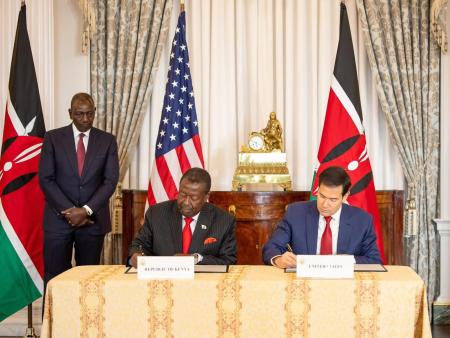
In the agreement signed by Kenya, it pledged to co-finance about $850 million (KES 110.5 billion) over five years to cover its domestic health expenditures, including health worker salaries, while the US will provide $1.6 billion (KES 208 billion) to Kenya’s health system.
Despite the promises of benefits, the new deal is raising questions about regulatory autonomy, transparency, and access to Kenya’s health data in the years ahead.
Counties blindsided
Two county directors of health told Defrontera the new deal echoes past instances where the national government made major health spending decisions without consulting them and then “offloaded the costs onto the counties," citing the medical equipment leasing scheme that left counties with machines they could not use or maintain. Kenya’s Council of Governors (COG) which coordinates the country’s 47 counties said it was not consulted and would issue a statement later, according to Mary Mwiti, the Chief Executive Officer of the COG.
Dr Gordon Okomo, the Homa Bay County Director of Health and chair of all country directors of health in Kenya, confirmed he was summoned but could not make it due to the sudden notice. Some counties, Defrontera has learnt, are now seeking clarity directly from the US CDC, saying the Kenyan government has not provided detailed information. “We will wait for more details from the national government,” Dr Okomo said.
Dr Andrew Mulwa, who heads Kenya’s National AIDS and STIs Control Program (NASCOP), said the MoU is a bilateral agreement and compared county concerns to expecting cities like Chicago and New York to be consulted on US foreign policy. “This is a government-to-government deal …when the time comes, the national government will call on the counties,” he said.
But unlike US cities, counties in Kenya run their own health services.
What Kenya gets
Kenya relies heavily on US support to finance its health sector. Before USAID was dismantled by the Trump administration earlier this year, it spent around $250 million annually to support Kenya’s health sector, including programmes for HIV, malaria, TB, maternal and child health.
The new deal promises some benefits for Kenya. The US will provide up to $1.7 billion (KES 221 billion) for diseases it had supported under USAID and ramp up outbreak response for infectious diseases. Kenya will receive the five-year financing for antiretroviral medicines (ARVs) for HIV patients, malaria commodities, lab reagents, and salaries for critical health staff. The US will also invest in upgrading labs to International Organization for Standardization (ISO) standards and improving Kenya’s health data systems, outbreak detection, and field epidemiology training for scientists.
Click to see Kenya's benefits
- Stronger Disease detection and response during outbreaks
- Build systems to detect outbreaks within 7 days
- Build capacity to respond within 7 days
- Improve disease detection institutions
- Train field epidemiologists (with U.S. support)
- Upgrade National Laboratories
- Add lab technicians to payroll
- Upgrade labs to ISO biosafety and quality standards
- Take over the lab supply chain and sample transport after 2027.
- Strengthen Supply Chain Systems
- Implement GS1 tracking for commodities
- Upgrade warehouses to ISO standards
- Create anti-theft and anti-diversion units
- Report theft of donor-funded items immediately.
- Expand and Stabilise the Health Workforce, cut the chronic understaffing of the Kenyan public health as Kenya adds to the government payroll:
- Lab staff
- Epidemiologists
- Medical officers
- Nurses
- Community health workers
- Roll out National Health Data Systems, a digitisation that creates efficiency and transparency in health services as Kenya must adopt:
- National Electronic Medical Records (EMRs)
- National lab systems
- Pharmacy systems
- Outbreak reporting systems
- Commodity inventory systems
- Better data accuracy and reporting, and force the ministry of health to maintain high data standards, where Kenya must:
- Improve the quality of health data
- Allow outcome surveys
- Allow process metric audits
- Participate in a joint steering committee to have structured coordination and planning to ensure that funds are directed where they are most needed.
Under the deal, the US will now work directly with the Kenyan government, and funding will be routed straight to Kenya’s government coffers, redirecting money away from non-governmental organisations (NGOs) – actors that have long filled the gaps in government services, offering direct care in remote areas in Kenya and providing swift responses in emergencies like pandemics and disasters.
Some officials see this shift to a government-to-government model, rather than routing US health funding through NGOs, as long overdue. Kenya’s Ministry of Health said donor programmes under USAID like the United States President's Emergency Plan for AIDS Relief (PEPFAR) and the Global Fund created “parallel systems” that were costly and fragmented, with only 40% of funding reaching frontline workers and commodities.
The costs for Kenya
Defrontera reviewed the MoU signed between Kenya and the US. The promises come with trade-offs for Kenya: The MoU grants the US broad rights over Kenya’s pathogen samples and health data, and requires Kenya to adopt sweeping regulatory changes.
Section 2.1.2 of the document commits Kenya to accept US Food and Drug Administration (FDA) approvals or Emergency Use Authorisations as sufficient for deploying medical countermeasures in Kenya during outbreaks. According to section 2.7 of the MoU, by 31 December 2026, Kenya must also amend its regulations to recognise FDA approvals as meeting all requirements of the Pharmacy and Poisons Board (PPB). All this could shift regulatory authority away from Kenya’s health agencies.
Click to see what's risky for Kenya
1) Fulfil performance targets or lose funding and punish citizens (through ARV shortages, etc.) for administrative failures for:
- 9 baselines that must not get worse from where they are now- percentage of PLHIV who know status, on ART, and are virally suppressed; cases of polio and measles; maternal, TB, Malaria, and under-5 deaths
- 28 targets that must improve each year, touching on infectious diseases, maternal health and others
2) Kenya takes over massive financial responsibilities nearly kes 11 billion (“co-investments”), a fiscal burden without parliamentary debate or public consultation. Kenya must gradually pay for:
-Lab commodities
-ARVs, malaria supplies
-Health worker salaries
-Data system maintenance
-Failure triggers:
-Funding cuts
-Loss of commodity support
-Possible termination of the MOU
3) Kenya shares all pathogen samples and genetic sequence data within 5 days, and this deal stays for 25 years.
4) Notify the U.S. of any disease outbreak within 1 day. US receives high-level biosecurity intelligence faster than the 47 counties or the Kenyan public.
5) Kenya Accepts FDA Approvals as Automatic Kenyan Approvals. Kenya will change its laws to treat FDA authorisation as sufficient for emergency medical products, weakening Kenya’s regulatory sovereignty (PPB), and risking public mistrust.
6) Kenya must allow Broad U.S. Audits of Kenyan Systems of:
-Health facilities
-Data systems
-Supply chain systems
-Financial accounts
-Compliance with U.S. laws
7) Agree to a Non-Binding MOU That circumvents parliament. The MOU “is not an international agreement… does not give rise to legal rights…” yet it creates financial obligations, legal changes, data obligations and regulatory commitments
8) Memorandum of Understanding is made between the United States Department of State and Kenya, with no mention of NGOs, civil society organisations (CSOs), or independent oversight. Government decisions are unchecked, communities lose representation, and no public safeguard against misuse of funds or authority.
The deal also carries the risk of funding cuts if Kenya falls short of performance targets. Kenya must hold steady on key “baseline” indicators such as the number of people with HIV who know their status, are on treatment, and have suppressed viral loads. It must also ensure that deaths from Malaria, TB, as well as under-five and maternal mortality do not rise. If Kenya does not maintain the baselines, “… the U.S. Government may substantially decrease or eliminate funding for one or more Areas of Cooperation in future years,” the MoU outlined.
Although government-to-government agreements aren't new, the push to integrate disease programs and work more directly through national systems mirrors a widening bipartisan consensus reflected in recent USAID and PEPFAR strategies. But the shift away from NGO-delivered services will put pressure on counties.
While the Ministry of Health continues explaining the deal to the public, county governments and the COG are still waiting to know how they will be involved when implementation begins next April. NGOs – long embedded in Kenya’s healthcare service delivery – are likewise uncertain about what their role will be going forward.
Defrontera reports on healthcare in Kenya, the innovation and politics, and how it all affects you. Subscribe to our newsletter, The Evidence, for updates.
Share this feature


