Ministry of Health risks losing KES 250m for family planning supplies after failing to seek release of funds
With Kenya already out of condoms, emergency contraceptive pills and implants, today is the Ministry of Health's last chance to request KES 250 million for family planning supplies.

Amid a chronic shortage of family planning supplies, the Ministry of Health risks losing KES 250 million earmarked for purchasing the commodities if it does not submit a request for the release of the funds by today, June 15.
The government had committed KES 500 million to purchase family planning commodities for the current financial year, but the national procurement agency, the Kenya Medical Supplies Authority (KEMSA), has received only half that amount.
During a meeting between health NGOs, the Ministry of Health and Members of Parliament last week, Treasury officials said funds can only be released from the Exchequer to ministries in Kenya through the established budgeting process.
“If there are any resources committed and not disbursed, the Treasury circular requires that requests be made by the 15th,” said Monica Asuna, Director of Planning at the National Treasury and Economic Planning.
Asuna said the Ministry of Health had not made the request. Dr Bashir Issak, Head of Family Health — the department within the Ministry of Health responsible for family planning — told Defrontera he was working with his team to meet the deadline.
“We are working on it,” Dr Bashir said.
The revelation comes as data from KEMSA shows severe stock-outs of family planning supplies. As of May 2026, KEMSA records show that the country had run out of both male and female condoms, emergency contraceptive pills and long-term family planning methods such as implants. Only three methods — intrauterine devices and inserts — remain available, and even these are expected to last only a few days.
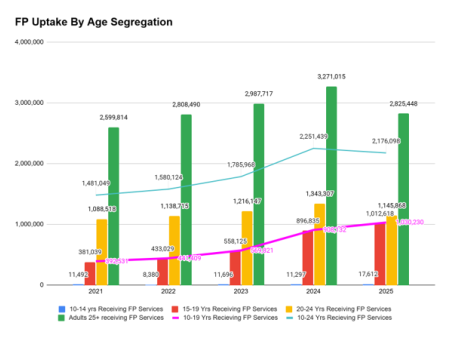
The need for family planning, however, has not declined, according to Ministry of Health data. Uptake of family planning among teenagers aged 10 to 19 increased by nearly four times, from 392,531 to 1,030,230 clients by 2025. There has, however, been a decline in uptake among women aged over 25, who are the largest consumers of contraceptives. Adults aged 25 years and above remained the largest beneficiary group throughout the period, increasing from 2,599,814 in 2021 to a peak of 3,271,015 in 2024 before declining to 2,825,448 clients in 2025.
With the procurement and delivery process for family planning commodities taking approximately 13 months — meaning that what is ordered today will arrive in Kenya next year — health experts have pointed to the consequences of the delay. The National Council for Population and Development (NCPD) estimates that a year-long stock-out would result in 1.2 million pregnancies, particularly among teenagers.
“The projected national consequences are 290,000 unsafe abortions and 4,000 maternal deaths,” a slide presented by NCPD showed.
The finance team and the Department of Family Health had not raised an AIE (Authority to Incur Expenditure), the document that authorises government departments to spend a specified amount of public or grant funds. The timeline for submitting this documentation for the second half of the financial year begins as early as February.
During the meeting, Treasury officials explained that the Ministry of Health has repeatedly delayed submitting the required documentation needed to draw down funds. This has affected not only the amount of money allocated but also the ministry’s ability to utilise the funds available to it. The budgeting process begins in July. Economist Nixon Murathi Kiratu, from the National Treasury, explained that having funds allocated does not necessarily mean a department or ministry will receive them.
“There are dire needs in the country, and if we see the money is not being utilised, Treasury will allocate it where it is needed. There is no need to park money where it is not used,” Dr Murathi said.
This suboptimal participation has also affected the procurement process, as KEMSA has had to conduct emergency procurements to address critical shortages.
Sources
Treasury's - budgeting processes
Share this feature

