How Nairobi’s Housing Could be Driving Spread of TB
Cramped housing, poor ventilation, and poverty are fuelling TB transmission in Kenya's richest city.


Michael Oluoch had always rubbished his cough as normal because of the dust he inhales at his work as a manual labourer on construction sites. In January this year, the cough persisted, with every whoop feeling like his chest would come out. He went to Tabitha Medical Centre near his house in Kibera, where he got the diagnosis that he has TB.
Living in Nairobi, the county with the highest number of cases of TB in the country, Michael has ideas of where he could have gotten infected: the construction site, the public service vehicles that he rides. After all, TB spreads when someone coughs, pushing bacteria into the air, and he could have walked into and inhaled that cloud of air.
Now, TB experts, such as Dr Jane Rahedi Ong'ang'o, who heads the Centre for Respiratory Diseases Research at the Kenya Medical Research Institute (KEMRI), are beginning to raise the concern that another factor could be causing the high TB incidence in Nairobi: the housing conditions in which they live. For the years she has studied tuberculosis, Dr Ong’ang’o has always noted the high cases of TB in the city.
In 2016, when she published Kenya’s first National TB Prevalence Survey, the capital city accounted for 15% of all confirmed TB cases in the country. When she carried out another survey in 2022, she and her team found “persistently high TB prevalence over a 7-year period in Nairobi County.”
Looking at her field notes, the researcher noted that the social factors that could explain the high cases of TB in the city, such as drug abuse and poverty, had not changed. All except housing.
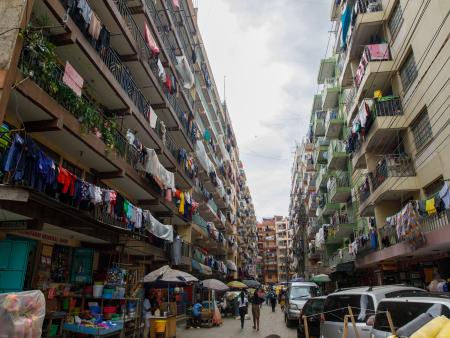
“There are a lot of high-rises, which were not there in 2016, and that may have contributed to this, and then the nature of the houses, poor ventilation, poor lighting,” Dr Ong’ang’o said.
Michael lives in a single room with his wife and two children. The houses in this community are similar, or as small as 12 square feet, equivalent to three wide strides, with as many as six people living in them. Kenya needs 250,000 housing units, but only an estimated 50,000 units are available, according to nonprofit Habitat for Humanity.
Agostina Mbwaya, a community health promoter who has worked in Kibera, says she has observed that most cases of TB are concentrated in the same neighbourhood, and she suspects the housing sizes.
Mbwaya explained: “The nature of our houses is very close together, separated only by iron sheets, and if a client has active TB, the bacteria travel, they float. It is easy for a person with TB to spread it to the next-door neighbour.”
This is a common denominator in Kenya. Eunice Kanana, the Meru County TB Coordinator, said that the common denominator in TB patients is “they really stay in small, congested places.”
Researchers have pointed to the connection between housing and TB, stating that it triples the odds of TB infection. It is not just enough that there is a roof over one’s head, but when there is no sunlight, ventilation, and it is damp, it increases the chances of inhaling the TB bacilli and infection.
The bacterium that causes TB, Mycobacterium tuberculosis, can fly through the air, and this is one of the reasons researchers are worried about housing and other social factors. In most cases, the body’s defence system can suppress the bacteria from growing. An astonishingly adept human pathogen, TB can remain in the body, alive and well, but silent and dormant, not causing any symptoms or spreading. These cases, called latent TB, are difficult to detect because chest X-rays and sputum tests will turn up a negative result. Poverty would exacerbate this; going to the hospital requires resources, and unless there is extreme pain, many would not seek care.
According to Dr Andrew Owuor, a pulmonologist and the head of the tuberculosis unit at Kenyatta National Hospital in Nairobi, poverty is linked to delay in care as well as housing.
“Because if people are poor, they'll tend to live in poor sanitary conditions, they will tend to overcrowd in rooms or sleep many of them in a room, and this makes it just very easy for tuberculosis,” Dr Owuor explains.
To prevent the infection in households with infected patients, like Michael, Kenya’s guidelines provide medicine so that members of the family who are not infected can avoid getting sick.
This story is part of Gasping for Breath, a special focus on Tuberculosis.
Sources
Persistently high TB prevalence in - Nairobi County neighbourhoods, 2015–2022
Population Matters paper on "Urbanisation challenges in Kenya’s Nairobi: a tangled web of issues" - describing how small the houses in Nairobi can be.
Habitat for Humanity's - research on housing needs in Kenya.
Investigating the Prevalence of Tuberculosis in Urban Slums - and how poor housing triples TB prevalence.
A systematic review of how - Inadequate housing drives transmission pulmonary tuberculosis.
Share this feature

