UNFPA: Kenya is yet to release earmarked funds for family planning
Requests for over $2.6 million to be used in addition to funds provided by the UN agency have failed, sources say.


The government of Kenya has fallen behind on an agreement it entered into with the United Nations Population Fund to provide matching funds for the procurement of contraceptive commodities, and repeated requests for the funds have been unsuccessful.
“We do not want to offend the Treasury, but they have always said that we delay in requesting those funds; they always say,” a source at the Ministry of Health of Kenya, who is not authorised to speak, said.
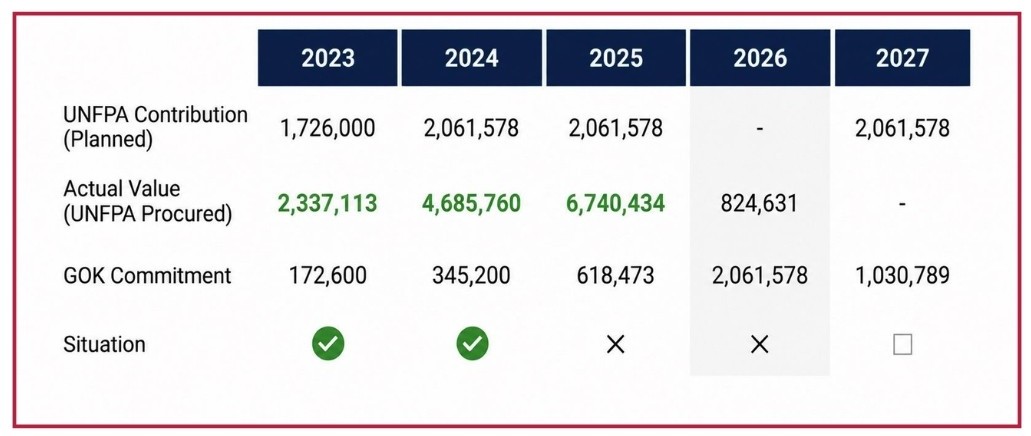
The funds in question include $618,473 (KES 80.4 million) and $2,061,578 (KES 268 million), which Kenya had committed to pay for the purchasing of contraceptive commodities meant for the 2025 and 2026 budget years. A document obtained by Defrontera showed that the government previously released money for the commodities in the years 2023 and 2024, as part of a UNFPA Supplies Match Fund agreement, which totalled $517,800, but it has yet to honour its commitment in recent years.
“If the GoK honours the $618,473 commitment with a 2:1 matching ratio (for the 2025 FY), they receive $618,473 × 2 ($1,236,946) through the 2025 Match Fund,” according to the document seen by Defrontera.
The UN’s sexual and reproductive health agency, UNFPA, is the world’s largest supplier of contraceptives and helps poorer countries secure uninterrupted supplies of modern contraceptives. They include birth control pills, male and female condoms, implants, among others.
In May 2024, Kenya signed a Supplies Partnership agreement with UNFPA, becoming one of the 44 countries with whom the UN agency has this agreement. Countries that enter into the partnership agree to pay a matching fund, where UNFPA would pay $2 worth of supplies for every $1 invested by a government, under the condition that the countries can only receive this benefit after paying the agreed-upon amounts.
Since signing the agreement with Kenya, however, UNFPA has spent as much as triple the amount of money it had planned each year for Kenya to purchase commodities, the documents showed, which the country has now completely run out of.
With donor funding dwindling, the UNFPA Supplies Matching Fund was designed to encourage countries to take ownership of funding the purchase of their family planning commodities, according to UNFPA Deputy Representative and Officer-in-Charge in Kenya, Dr Pilar de la Corte Molina. “It’s not only about the impact on health, but also the impact that family planning has on education, in job creation and socioeconomic development,” Dr De la Corte said.
Dr De la Corte said the money from the government would go to training health providers to ensure that “everyone who wants to do family planning at the last minute has access to modern methods of family planning.”
He adds that the partnership between Kenya and UNFPA is beneficial and a two-way street: Kenya would access new and lesser-used family planning commodities, and UNFPA would help the government purchase reproductive health supplies that have been certified to be safe at competitive prices through its global procurement system.
The Treasury and the Ministry of Health (MoH) of Kenya did not respond to Defrontera’s several requests for comments to explain why the funds had not been paid to UNFPA. In June, the Treasury said the MoH often failed to submit documents to the finance ministry on time, as laid out in the budgeting cycle, to secure the release of funds.
Sources
UNFPA supplies partnership: - Annual Report 2024.
EXCLUSIVE: Kenya’s - contraceptives crisis (Jan 2026
Share this feature


