Kenya rolls out breakthrough HIV drug. Now the real test begins.
The first 21,000 doses of Lenacapavir arrived in the country this week, but there are uncertainties on testing and long-term financing, which could hold uptake back.


Kenya has begun to rollout a breakthrough drug for HIV prevention. The move would be a game changer in the country’s battle against HIV, health professionals say, but testing and financing bottlenecks could put the brakes on the successful rolling out of the drug across the country.
The drug is Lenacapavir (currently marketed as Sunlenca for HIV treatment and Yeztugo for PreP), a long acting, twice-yearly injectable, pre-exposure prophylaxis (PreP) drug that prevents HIV infection. The first 21,000 doses of the drug arrived in the country early this week, purchased by the Global Fund with funding from the United States government. The Ministry of Health of Kenya says another 12,000 continuation doses are expected by April for those initiated on treatment, alongside an additional 25,000 doses from the US government to support the early stages of implementation.
Yet Kenya has a national HIV prevalence of about 3% – roughly 1.33 million people living with HIV – and around 20,000 new infections each year, but for the most part, officials from the health ministry have not detailed how it will secure sufficient supplies beyond the initial consignments.
PEPFAR, a programme housed within the now defunct US Agency for International Development (USAID), funded most of Kenya’s HIV care and treatment, underscoring the country’s reliance on external support. The Kenyan government did not disclose how it plans to secure future supplies, but Dr Barbara Mambo, the head of HIV Prevention at the Ministry of Health’s Division of National AIDS and STI Control Program (NASCOP), said it would cost the government KES 7,800 (about 60 USD) per person annually. The drugs will be provided to the public for free.
“For eligible individuals, PrEP — including Lenacapavir — will be offered as a choice and free of charge,” wrote Dr Mambo in an e-mail to Defrontera. “This ensures that cost will not be a barrier to access, particularly for vulnerable populations who need it most.”
Rolling out Lenacapavir efficiently requires testing, and only people who are HIV negative are eligible to get it. Without testing, it would be difficult and medically unsafe to give the PreP, said Dr Patrick Oyaro, a public health specialist. “People know their HIV status only through testing,” said Oyaro. That’s why testing capacity and follow-up systems are key to rolling out the drug. But questions to NASCOP about whether Kenya has sufficient testing kits to conduct HIV tests drew vague responses.
Having trained health workers who can deliver the injection is another factor that will test the rollout of the PreP in Kenya, according to Mitchell Warren, executive director of the AIDS Vaccine Advocacy Coalition (AVAC), an international nonprofit based in New York City. “PrEP has never been just a pill or an injection; its success is beyond buying the medicines,” said Warren. The government would need to raise awareness about Lenacapavir, he said.
Want to stay updated on what’s happening in healthcare in Kenya? Sign up for De-Evidence, and we’ll send our latest coverage to your inbox.
NASCOP told Defrontera that measures were being taken to ensure a successful rollout of Lenacapavir, including training healthcare workers and engaging communities to increase demand and uptake at health facilities. However, there’s no evidence that such training or health education efforts have taken place. NGOs involved in introducing similar HIV prevention methods in Kenya said that amid acute funding shortages, the government may have to rely on the health workers previously trained to rollout oral PrEP in 2015.
But the challenges extend beyond all this. Dr Mambo said that funding uncertainty can slow rollout of the drug, acknowledging that PEPFAR’s exit has created challenges — commodity distribution disruptions, facility closures, and higher costs for KEMSA. “The country is at risk of interruptions,” Dr Mambo said.
Safeguarding future
Despite the set of challenges ahead, Dr Mambo said that the drug rollout is a chance to cut new HIV infections, particularly among pregnant and breastfeeding women and adolescent girls and young women, who account for a disproportionate share of new HIV cases. “These groups remain highly vulnerable. By protecting them, Kenya is safeguarding future generations and accelerating progress towards ending the epidemic,” wrote Dr Mambo for NASCOP.
In its analysis of the impact of donor withdrawal last year, the government revealed that Kenya pays for just 11% (KES 3.1 billion) of the total KES 28 billion (about $218 million) that the country needs to offer all HIV care and treatment services. The rest of the money came from the Global Fund (57%) and the US government (32%). In a presentation last year to counties’ executives for health, Dr Ruth Masha, the head of the National Syndemic Diseases Control Council (NSDCC), which is the body that manages policies for HIV and other infectious diseases, estimated that prevention activities alone cost US$51.6 million (around KES 6.6 billion).
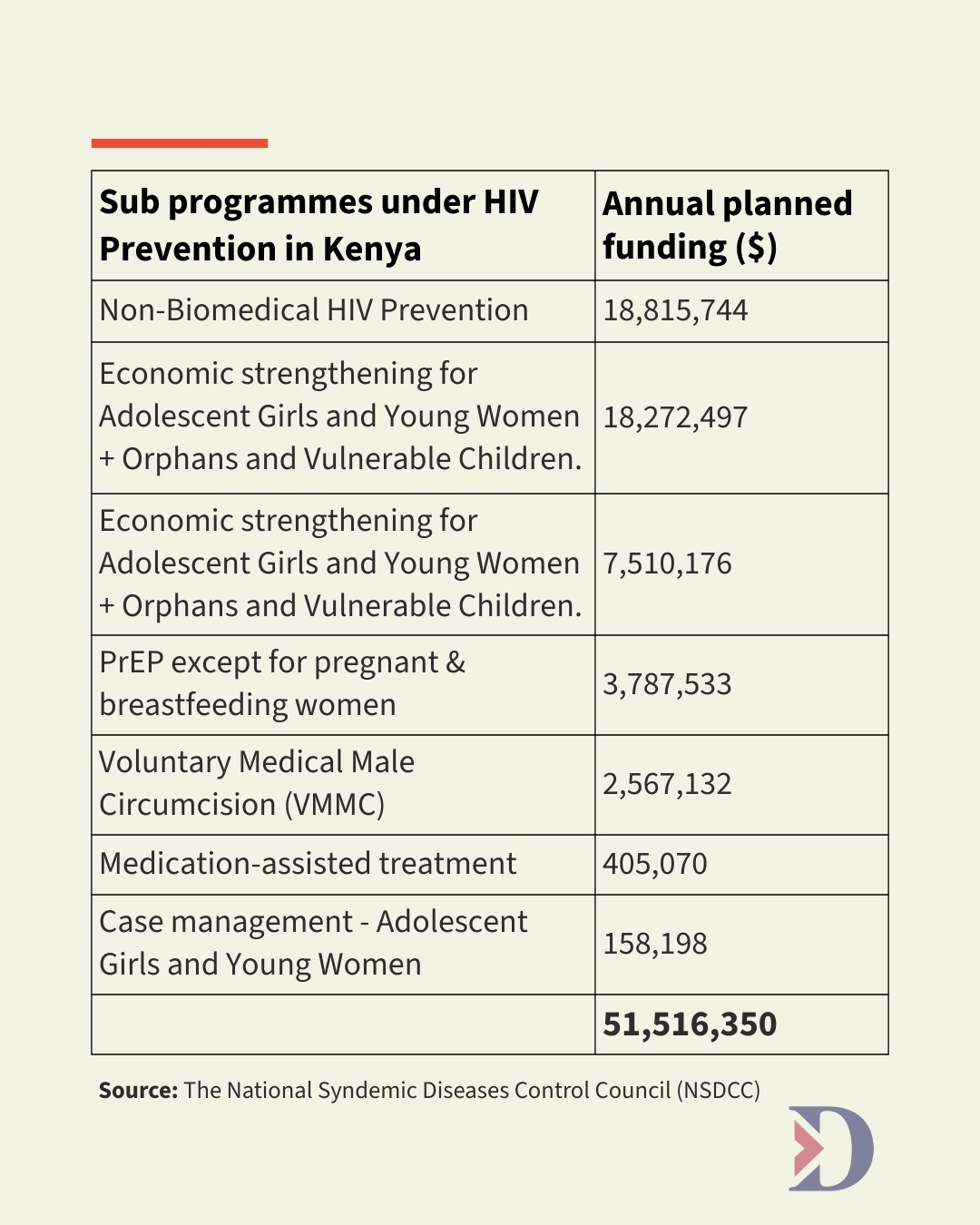
Public health advocates warn that without domestic financing, the opportunity could be squandered. Warren said Kenya has faced similar challenges before. Oral PreP was shown to be safe and effective in 2010, yet it took five years before it was approved in the country. This time, regulators moved faster. The national Pharmacy and Poisons Board (PPB) registered Lenacapavir in January 2026, just seven months after a June 2025 endorsement by the World Health Organization. Treasury declarations following donor funding cuts indicate that Kenya has, to a large extent, maintained its previous funding levels rather than increasing funds.
For now, the Ministry of Health’s strategy rests on securing additional resources from the government.
“Domestic resource mobilisation and innovative financing mechanisms will be needed to fill these gaps and ensure uninterrupted services,” Dr Mambo wrote.
Sources
Government analysis into - impact of donor withdrawal in Kenya.
The Ministry of Health of Kenya's announcement - of receiving the first dose of lenacapavir.
Share this feature

