A recent government order withdrew 77 toxic pesticides, but Kenyans are not out of harm’s way
Kenya outlawed 77 pesticides to protect people and the environment — but Defrontera’s five-county probe shows the ban is faltering. Sellers have pulled banned brands, yet equally toxic products reappear under different marketing names. Farmers still buy chemicals so lethal that a few drops can kill, many classified by the WHO as Class Ia or Ib — the deadliest categories.


It seems that the widespread praise of a government order withdrawing 77 pesticides over safety concerns may have been premature, after all, as questions emerge over enforcement and ambiguity in classification that could allow harmful substances to remain in circulation.
A multi-county survey by Defrontera targeting 30 outlets in the breadbasket areas of Kitale, Eldoret, and Kiambu, as well as peri-urban settlements in Kajiado and Nairobi, yielded conflicting results. While many agrovet shop operators, a vital link in enforcing the ban, confirmed that they had withdrawn the banned pesticides, they were unclear about the sale of substances that contained the "active ingredients" of the 77 banned pesticides.
Last June, the Ministry of Agriculture withdrew 77 pesticide products registered in the country due to the harm they could cause to people, animals, water, and soil. Agriculture Cabinet Secretary Mutahi Kagwe said the government was keen on achieving two objectives, namely, restricting 202 products, permitting their use only under the guidance of a specialist and for specific jobs, and, according to the Pest Control Products Board (PCPB), placing another set of 151 under review, with results expected in December 2025 on whether Kenya will import the products.
A spot check by Defrontera targeted the counties of Kiambu, Trans-Nzoia, and Uasin Gishu, whose mainstay is agriculture, while Nairobi and Kajiado were selected for their urban subsistence farming. From the streets of Nairobi—Tom Mboya Street, Moi Avenue, Haile Selassie Avenue and lower downtown—the banned and restricted products were no longer on the shelves. The shops in Kiambu County and Ngong Town in Kajiado County also did not have the products.
The traders in Kiambu and Nairobi counties were aware of the banned products and the dangers they posed to people, animals, and the environment. The sellers warned against using prohibited and restricted products. However, when Defrontera reporters pressed the sellers for the names of the banned substances, only a few could provide them. The weakest link in enforcing the ban, however, was the manifest ignorance of which brands contained active ingredients in the pesticides withdrawn from circulation.
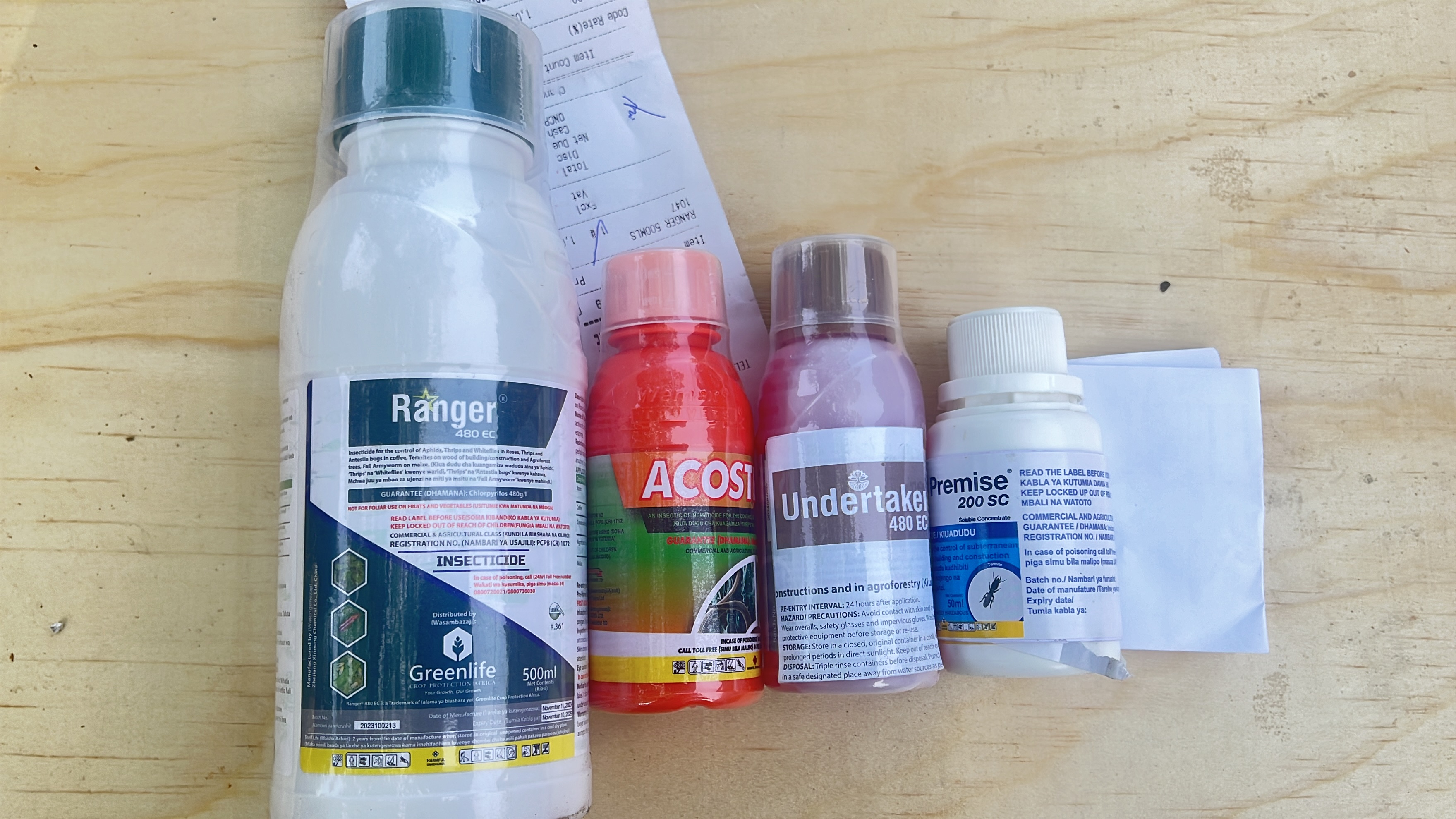
By only listing banned active ingredients, the government failed to name the exact pesticides and brands that were harming Kenyans—probably killing Kenyans—especially given the levels of poison in the banned or restricted products. For instance, in Kitale, the reporters did not find chlorpyrifos, but an agrovet attendant looking through his shelves found Ranger 480EC and Undertaker 480EC, which had the restricted ingredient chlorpyrifos. On a typical day, he would simply sell it without explaining its dangers and without asking how we intended to use it.
Nearly one in every two of the 77 pesticide products that the government banned or restricted was classified by the World Health Organization (WHO) as Class Ia or Ib—the most dangerous categories of highly hazardous substances. The WHO ranks pesticides by their toxicity to humans, using a scale from Class Ia to Class III. Class Ia or Ib pesticides can kill with just a few drops if swallowed or exposed on the skin, causing massive organ failure, and often do not have an antidote due to the fast manner in which they are absorbed in the human body. Any of the pesticides classified in both groups are so poisonous that health agencies recommend they be phased out entirely, especially in low-income countries where farmers often handle them without protective gear.
In Europe, the source of many of the harmful pesticides in Kenya, the rules are different: before anyone sprays a restricted product, they must typically be certified, have recent training, use approved equipment, and often receive written advice from an accredited adviser. The government enforces these rules through regular inspections, checks on sales records, and testing crops for residues.
Save for the laws on paper, Defrontera found no evidence of strict monitoring of restricted products in Kenya. There is evidence, however, that as many as 385 million cases of unintentional, acute pesticide poisoning occur in the world every year. Fredrick Muchiri, the Chief Executive Officer of the Pesticide Control Products Board (PCPB), stated that following the June order, the government will cease any further importation of the products. Mr Muchiri noted that the board has also “intensified” inspection of the local manufacturers to ensure they comply with safety protocols.
“We have officers at the airports and any other points of entry in Kenya, and there are also officers in the counties to check the shops regularly if the products are still in circulation,” Mr Muchiri said in a phone interview.
In Kitale, Trans-Nzoia County, Kenya’s breadbasket, two products—Ranger 480EC and Undertaker 480EC—containing the restricted ingredient chlorpyrifos were found. In just three of the 30 agrovets in Kitale, Defrontera accessed these substances with ease. The shops issued receipts as proof of these purchases. None of the sellers was aware of the dangers of the ingredient chlorpyrifos. When pressed, the sellers issued a blanket “use them carefully” without elaboration.
WATCH: How double standards in global pesticide trade are poisoning Kenya’s food systems.
Chlorpyrifos, an insecticide preferred by farmers due to its modest cost (Sh1000 for a 500ml pack and Sh250 for a 100ml) and lethal consequences on a wide range of insects and pests, is an organophosphate. Exposure to it for an extended period causes serious neurological problems. Recent studies have shown that children born to mothers exposed to chlorpyrifos had foetal growth restriction, including smaller head size, lower birth weight, abnormal newborn reflexes, and neurodevelopmental symptoms in toddlers, including autism spectrum disorder, inattention and lower overall intelligence.
Manufacturers of these harmful products aggressively defend them, often insisting that illness is actuated by multiple factors—from genetic predisposition to environmental causes. Consequently, data and studies linking actual harm to exposure to chlorpyrifos can be dismissed as unfounded, but it is hard to ignore how organophosphates like chlorpyrifos kill insects.
According to the United Nations Environment Programme (UNEP), chlorpyrifos kills pests by attacking and destroying their nervous systems; pests’ nervous systems resemble those of mammals, such as humans. The substance prevents the breakdown of acetylcholine, the chemical messenger that allows nerves to communicate with other parts of the body, such as muscle fibres or glands. When acetylcholine accumulates in the body, people experience adverse health effects, from muscle twitches to learning and memory impairments.
Yet, farmers, both male and female, do not wear protective gear, as multiple studies have shown. Route to Food Initiative (RTFI), a programme of the Heinrich Böll Foundation in Kenya, also reported that only a paltry 15 per cent of farmers stored pesticides away from children. Farmers who are unaware of the restricted ingredients and the names under which they are sold expose them and the public to grave danger, given the numerous imports that come to Kenya.
In Eldoret in Uasin Gishu, Kenya’s largest maize-producing county, the agrovets did not have restricted products but promised to alert Defrontera “when new stock comes”. The sellers referred Defrontera to much bigger shops where they said the products could be available at wholesale prices. But we only found the restricted products in those bigger shops.
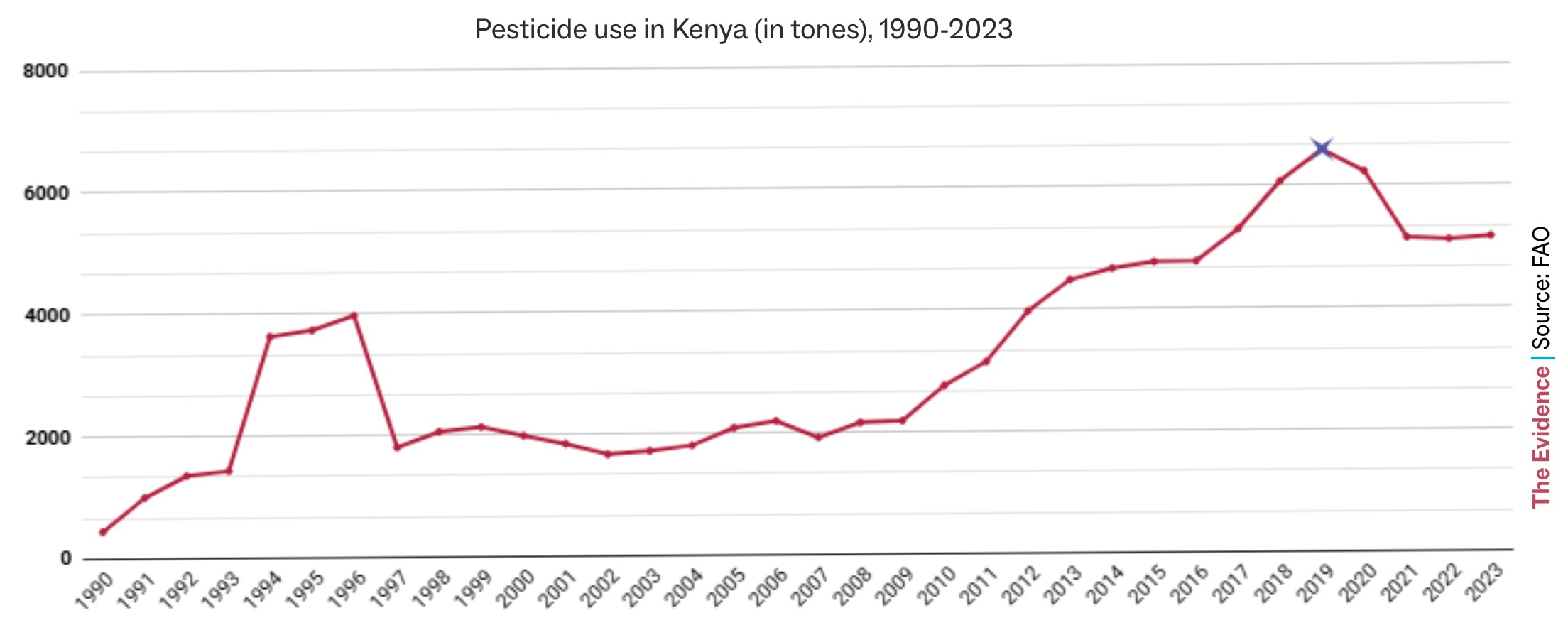
The lack of awareness among farmers is a cause for concern since pesticide use in Kenya has increased by over 1,000 per cent—from about 400 tonnes to 5,162—according to the Food and Agriculture Organization (FAO). Most of these imports come from Europe, where they are banned, showing the double standards.
There are safer pesticides available to farmers, but they account for only 2 per cent (47.3 t) of the total pesticide volume used in Kenya. Furthermore, they are used mainly on beans, a significant export crop to Europe, according to the Route to Food Initiative 2023 report. The safer pesticides are costlier: a farmer needs 50 times more of the safer pesticide Achook than the toxic ones because, for every hectare, farmers use 50 grams as compared to 2,500 grams of the safer pesticides.
It is hardly surprising that there are residues of these harmful chemicals in food. An analysis by the Kenya Organic Agriculture Network found pesticide residues in all the samples from three markets in 2020. The report concluded: “One or more pesticide concentrations exceeded the Maximum Residue Level (MRL) set by Kenyan authorities, as informed by European standards (Figure 10). Most notably, the levels of acephate, a pesticide already withdrawn in Europe, exceeded the allowed MRL in all three markets.”
Hesborn Etyang (Reporting in Uasin Gishu and Trans Nzoia). Editing (Peter Kimani); Graphic Design (Michael Omondi)
Share this feature

