Kenyan counties in a bind as measles stages a comeback amid vaccination funding cuts
Measles is surging again in Kenya — with over 3,000 cases and 18 deaths reported in 11 counties over the past year. Vaccine funding has collapsed, leaving the country dangerously exposed, as the government is covering only a fraction of what’s required. Experts warn: herd immunity is breaking down, and the long-term consequences could be fatal.


Measles, a virus labelled as “the world’s most contagious” by health experts, is endemic in Kenya—meaning it is now part of the diseases that regularly occur in the country—but it is making a deadly comeback amid funding cuts for vaccines, in what could add further strain to the disease burden of East Africa’s largest economy.
The outbreaks bulletin from the World Health Organization (WHO) reveals that there have been nearly 3,000 cases of measles in Kenya in the past year. By mid-March, the country had recorded 18 deaths caused by measles, including children under five.
The outbreaks are continuing barely a month after Kenya’s Ministry of Health quietly released an analysis of the gap left by the withdrawal of US government support for its healthcare system. In the report, the ministry noted that the country requires KES 11.6 billion annually for immunisations, but the government only covers a fifth (KES 2 billion) of this amount.
With funding cuts from the US government, the report noted that “Gavi covers 56% of these commodities; the absence of a waiver for USG contributions affects a crucial 5% of the overall programme,” leaving a gap of KES 2.5 billion. Two weeks after the ministry released the report, The New York Times reported that the US government was planning to terminate support to Gavi, the organisation that helps purchase more than half of Kenya’s vaccines.
The report is already apportioning blame: “With the government yet to fulfil its pledged contributions, the immunisation programme risks falling into a critical shortfall, which could undermine nationwide efforts to prevent vaccine-preventable diseases.”
Even with these gaps, Kenya’s exchequer has drastically cut the health budget for the next financial year. Kenya’s National Vaccines and Immunisation Programme (NVIP) did not respond to Defrontera’s questions on how it intended to fill the funding gap.
Lifetime consequences
This funding shortfall—and the government’s lethargic response—has given measles a window to wreak havoc. The virus had previously been concentrated in border counties but has now spread to 11 counties, including Kajiado, Nakuru, Kiambu, and even the capital, Nairobi.
Dr Christine Chege, a paediatric infectious diseases specialist based at the Kenyatta University Teaching and Referral Hospital (KUTRH) in Nairobi, described an eight-month-old baby she had treated for measles.
“The baby did not have the other serious complications that often come with measles, like pneumonia, but it was very ill and had to stay in hospital for two weeks,” she said.
While the baby survived, the doctor expressed concern about the child’s future, given the complications that can develop even after surviving measles. She listed several, including subacute sclerosing panencephalitis (SSPE), a fatal disease of the brain that can develop years after a measles infection.
Dr Chege, who also heads the Paediatric Department at KUTRH, said she had not personally lost any patients to measles but had heard of fatalities from colleagues — “a child lost here and another there” — because of the disease.
Like Dr Chege, many paediatricians told Defrontera that while they were familiar with measles from their medical training, they had rarely seen cases in children under five—until recently. Now, they are seeing more cases, including among older children above five.
As vaccination is a proven method of protecting populations against measles, health experts identify gaps in immunisation as the weakest link in the fight.
“It is a breakdown of the immunisation system—our failure to tackle vaccine hesitancy due to misinformation,” Dr Chege said.
Measles is part of the routine childhood immunisation schedule in Kenya. According to the Ministry of Health’s guidelines, children under two years are considered fully vaccinated against all basic antigens and receive an additional oral polio vaccine, a dose of inactivated polio vaccine, three doses of the pneumonia vaccine, and two doses of the rotavirus vaccine.
Vaccination coverage must be above 95%.
The basic antigens include a dose of BCG vaccine (for tuberculosis); three doses of oral polio vaccine or a combination of oral and inactivated forms; three doses of a DPT-containing vaccine (protecting against diphtheria, pertussis [whooping cough], and tetanus); and a measles-containing vaccine given as measles-rubella (MR).
However, like many aspects of healthcare in Kenya, access to vaccines is determined by a child’s place of birth. Counties in the Northern Frontier and arid and semi-arid areas, such as Mandera (6%) and West Pokot (11%), have extremely low vaccination rates. Others, like Tharaka Nithi and Kisii, have rates as high as 82%, according to the 2022 Kenya Demographic Health Survey.
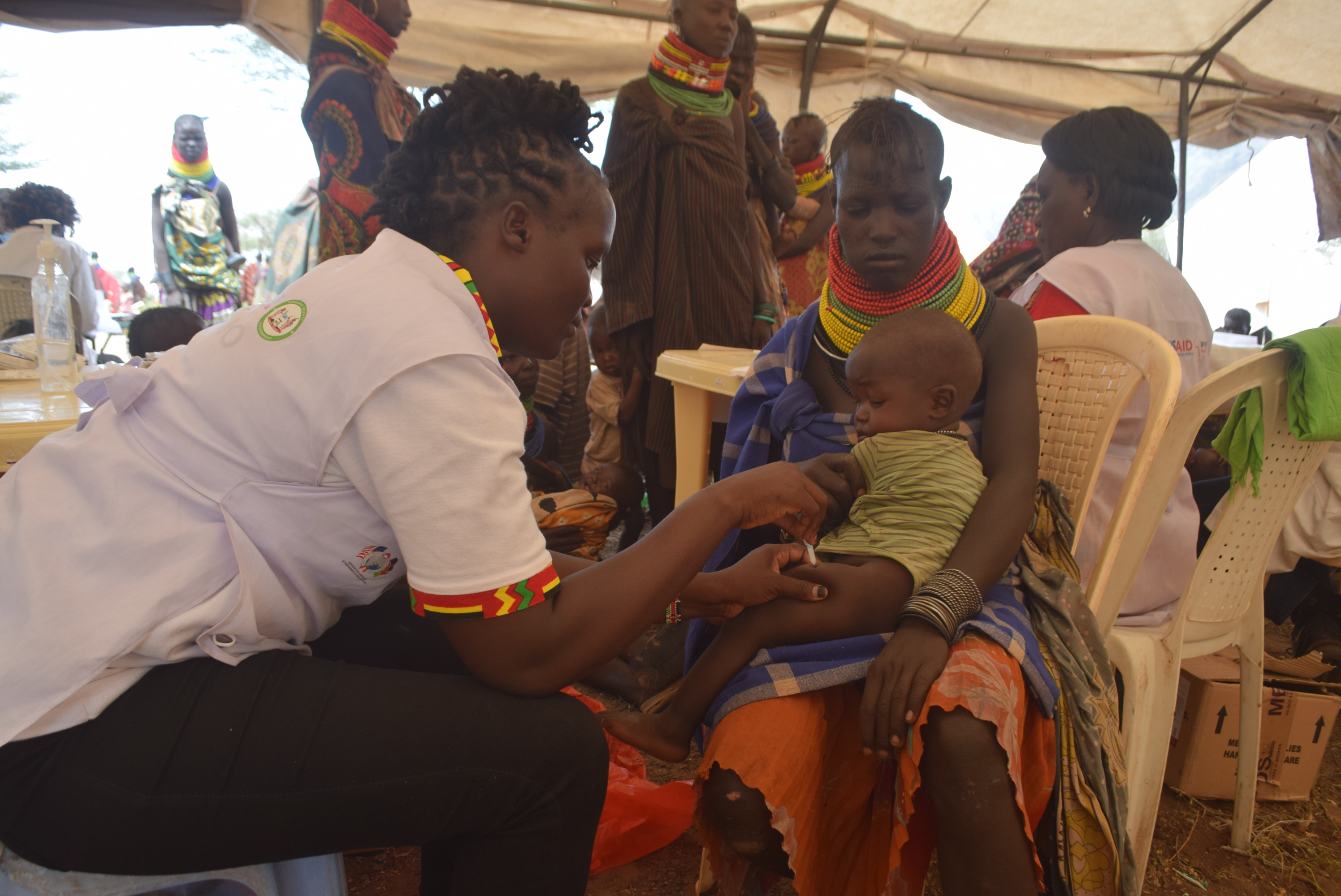
These low rates, especially in border counties, are concerning because measles outbreaks are often traced to refugee settlements and counties bordering conflict-affected countries with weak vaccination systems, such as Somalia and South Sudan.
Turkana, which borders three conflict-prone countries—Uganda, South Sudan, and Ethiopia—has reported 1,444 cases of measles and nearly a dozen deaths as of May 2025, according to the county’s Health Department. The county hosts Kenya’s second-largest refugee camp, Kakuma, with 303,247 refugees. The county’s health executive, Dr Joseph Epem, told Defrontera:
“Nine in ten cases—about 87 percent—come from Turkana West Sub-County, which includes the Kakuma refugee camp.”
With only 29% of children in the county fully vaccinated, Dr Epem fears that the virus will spread even further, especially now that vaccine funding has been slashed. Other health experts outside Turkana are also worried about the implications of such low vaccination coverage.
Prof. Omu Anzala, a virologist at the KAVI-Institute of Clinical Research at the University of Nairobi, emphasised that due to the highly infectious nature of the measles virus, Kenya’s vaccination coverage must be above 95%, as recommended by WHO.
Prof. Anzala explained the concept of herd immunity, where a sufficiently large proportion of the population is immune to a contagious disease, thereby preventing its spread.
“If less than 95% of the population is vaccinated, it means herd immunity erodes—and those with weak immune systems or who have not received the second dose of the measles vaccine will fall ill,” he said.
Read about Turkana County’s unusual #LifeSavingInnovations to ensure every child is vaccinated.
Share this feature


